Archive | Recipes RSS feed for this section

Lessons in Indian

21 Nov

Since my friend Anjali visited last year and Jan and I got our first lesson on cooking Indian food (see Indian Feast Masala), we were not very good students. Jan made one other dish from Madhur Jaffrey’s Quick & Easy Indian Cooking (Stir-Fried Green Cabbage with Fennel Seeds, or bhuni bahdh gobi) for me to bring to my book club when the food theme for that night was Indian (we were discussing The White Tiger), and then, we made nothing else for a while.

And then, in typical fashion for us, suddenly it was all about Indian food. Though I’ve never been a fan of curry, dinners out and about (at North India Bar and Grill and Malabar Restaurant in Santa Cruz) convinced me that there was so much more than curry to get me excited about Indian. I learned early on that I love naan, and also all the different pickles and chutneys that go along with them.

At home, we again made the onion fritters and lentils from our introductory lesson, and began to try some other recipes from the book (thanks again Laura!). An instant hit was the spicy grilled chicken or masalewala murgh, and we had fun sampling that with a few prepared chutneys.

One night, the combination of dishes was right on. With the chicken on the grill and the cabbage on the stovetop, we followed the recipe for Indian Mashed Potatoes or mash aloo.  We reserved a portion of the mashed potatoes that were prepared according to the recipe (delicious this way), and the other portion was an experiment sparked by something we’d heard about on a cooking show.  By searching for more Indian recipes online, we found what we were looking for: mashed potato balls, though the more appropriate name was batata vada, which translates to “potato fritters.”  To make them, we rolled ping-pong-ball-sized pieces of mashed potatoes into chickpea flour (besan) that had turmeric added to it. I deep fried the mashed potato balls until the outsides looked golden brown and crispy.

Mashed potato balls after a dusting of chickpea flour

Into the hot oil

Deep fried deliciousness

Since the mashed potato balls were so delicious, I decided we’d make them for an Indian food themed dinner party we were hosting.  And since I was so excited about my newly acquired tool for forming meatballs (looked like scissor handles with ice cream scoops on each end), I thought that would help me make perfectly shaped mashed potato balls.  That, however, proved to be a mistake.  Because I hadn’t formed the balls by hand, the potatoes were not firmly pushed into shape.  When they were deep fried, they quickly began to fall apart.  So after all that, what we ended up with was basically just mashed potatoes that had a lot more grease in them than if we’d just left them alone.

A few other lessons learned: the marinade for the spicy grilled chicken (following proper food safety and reserving some separately from what is used for marinating the chicken) makes an amazing sauce to dip naan, potatoes, cabbage, and anything else on the plate. Also, Trader Joe’s is a great place to buy naan—they offer several different varieties in their freezer section, and they heat quickly and perfectly in the oven at home.

Clockwise from top: Spicy Grilled Chicken, Stir-Fried Green Cabbage with Fennel Seeds, and Mashed Potato Balls

Now being perfected: Stir-fried Shrimp in an Aromatic Tomato-Cream Sauce (ghagari jhinga), and the cooling Yogurt with Tomato and Cucumber (timatar aur kheeray ka raita)

We still have many more lessons to learn in Indian cooking, but I’m enjoying all the taste-testing along the way. So far, the lentils have been the hardest to perfect, but I’ve been polling Indian friends for their tips (so far, the best seems to be soaking them overnight first, then using a slow-cooker or crock pot to prepare).

Here’s the recipe for spicy grilled chicken modified from the recipe in Quick & Easy Indian Cooking, and recipes for mashed potatoes and cabbage should follow in the weeks to come.

Spicy grilled chicken—masalewala murgh

print recipe

INGREDIENTS

  • 2 pounds boneless chicken thighs or breasts

For the marinade and sauce

  • 1 tablespoon garam masala
  • 2 teaspoons ground peppercorns
  • 2 teaspoons oregano
  • 2 teaspoons cumin
  • 1 teaspoon salt
  • 1 teaspoon paprika
  • ½ teaspoon cayenne pepper
  • ¼ teaspoon turmeric
  • 1 clove garlic, crushed
  • 2 tablespoons lemon juice and some zest
  • 1/2 cup plain yogurt, plus an additional 1/2 cup to use later to make the dipping sauce
  • ½ cup canola oil

METHOD

  1. Combine marinade/sauce ingredients in a medium bowl.
  2. Divide contents in half; use half to coat chicken and let marinate sit for 2 to 4 hours in refrigerator.
  3. Barbecue or grill chicken until done, approximately 10 to 15 min.
  4. With the reserved marinade (not what was used with the chicken), add additional ½ cup yogurt and mix thoroughly to serve as a dipping sauce.

Black Forest Cupcakes & Oktoberfest

7 Nov

Last year, Jan and I couldn’t get our act together in time for an Oktoberfest party in October, so we hosted one in November and called it “Noktoberfest” (see Lederhosen and Lebkuchen). Continuing the tardy tradition, we managed to host an Oktoberfest celebration this October, but it’s taken me until November to write about it.  Maybe next year I’ll get them both done in October!  And a few years down the line, I might actually be on schedule with Munich, which begins the 16-18 day beer festival in late September.

In any case, with a couple of other projects currently at the top of our priority list, this year’s Oktoberfest was a toned-down celebration, with Jan limiting the menu to (only!) four types of German sausages, plus meat-free sausages for our vegetarian guests. We brought back out our ridiculous costumes (lederhosen for the men, dirndls for the women), served sauerkraut, red potatoes, braised cabbage, and potato salad, and kept the drink menu simple with the obligatory Oktoberfest beverage: beer.  And while I enjoyed the silliness of decorating wearable lebkuchen cookies with my guests last year, this time opted for Black Forest cupcakes, and there was a lot less icing all over the house at the end of the evening.

Getting ready for the grill

Going overboard with the sausage selection?

The recipe for the chocolate cake came from AllRecipes.com (recipe here), and instead of using Kirsch (cherry liqueur) in the actual cake (again being lazy about a trip to BevMo), I soaked the cherries in brandy to give the cupcakes the slightly alcoholic flavor they needed.

The chocolate cupcakes before getting stuffed with brandy-soaked cherries

Black Forest Cupcakes

print recipe

INGREDIENTS

Cake

  • 1 (18.25 ounce) package devil’s food cake mix
  • 1 (5.9 ounce) package instant chocolate pudding mix
  • 1 cup sour cream
  • 1 cup vegetable oil
  • 4 eggs
  • ½ cup warm water
  • 1 cup semisweet chocolate chips

“Black Forest”

  • 1 can tart cherries (in water, NOT syrup)
  • 1 to 2 cups brandy or Kirsch
  • 1/4 pint hipping cream
  • 1-2 tablespoons powdered sugar
  • 1 dark chocolate bar
  • 24 Maraschino cherries

METHOD

  1. Preheat oven to 350°F.
  2. Drain cherries and place in a small bowl.  Pour the brandy over the cherries until they are completely covered with liquid, set aside.
  3. In a large bowl, mix cake mix, pudding mix, sour cream, oil, beaten eggs, and water. Stir in chocolate chips and pour batter into 24 paper cupcake cups.
  4. Bake for about 18-20 minutes, or until tops are springy to the touch and a toothpick inserted in the center comes out clean.  Cool cupcakes thoroughly.
  5. Drain the cherries again and roughly chop into quarters.
  6. Use a knife to cut partially through the top of the cupcakes, just above the paper cup.  Using your fingers or a spoon, stuff about 1 tablespoon of the cherries inside the cupcakes.
  7. Use an electric mixer to whip the whipped cream, adding powdered sugar until you have the desired sweetness (I added about 1.5 tablespoons to a ¼ pint whipped cream).
  8. Spread whipped cream over the stuffed cupcakes.
  9. Use a potato peeler to shave thin pieces from the dark chocolate bar, sprinkle over tops of cupcakes and top each with a maraschino cherry.

Baby Got Baklava

17 Oct

When I told a few people my plans for Sunday, everyone seemed worried.  “Isn’t that really hard to make?” they’d ask, referring to the baklava I said I would spend the morning making. I’d been tasked with making baklava—the Mediterranean dessert made of layered phyllo dough and nuts—for my dad’s wedding reception, to go along with the Armenian food that would be catered for the event.  Though I’d warned that I’d only made baklava one time before with not-so-great results, I welcomed the challenge, and hoped I’d have better luck and be able to positively contribute to the celebratory meal.

I began by researching baklava recipes, and found that the dessert is prepared in many different ways, depending on the culture, and can have infinite fillings, though the most common include walnuts and pistachios.  Because eating walnuts causes me to feel like I’ve eaten a serving of chalk, I knew right off the bat that I’d have to get a little more creative with the baklava I made.  Remembering the delicious chocolate baklava I’d sampled from the Fresno Greek Fest the month before, I knew chocolate was at the top of my list.  I’d also been curious about Sun-Maid’s Raisin Baklava recipe ever since I’d seen it.  When I found a recipe for Chocolate Walnut-Raisin Baklava, I knew I’d found the recipe to make.  

But after reading through the recipe, and another baklava recipe, and yet another one, I wasn’t sure what to do next. They all directed a different way to layer, fill, and fold the dough; I wasn’t sure what I should be doing at all.  I was in the kitchen, with my recipe printed on two sheets of white paper, folding and placing the sheets on top of one another, when Jan walked in and, laughing at the perplexed look on my face, asked what I was doing.  When I told him I was practicing making baklava with paper sheets before I got to the real phyllo dough, he said I needed a different approach and suggested YouTube.

As usual, he was right.  After I watched both videos from Dede’s Mediterranean Kitchen, I felt empowered.  I was making baklava and it was going to be easy and delicious

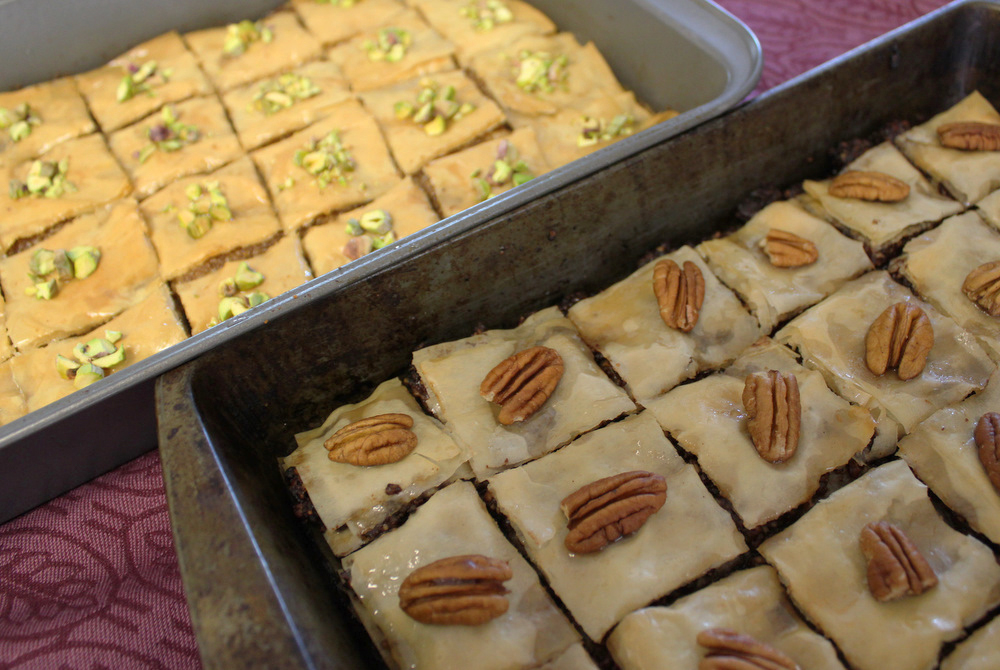
And, after seeing it done the right way, it was.  I made a few modifications to the original Chocolate Walnut-Raisin recipe, and it came out of the oven looking beautiful. I still had half the box of of phyllo dough sheets left, so I made a second batch, this time following Dede’s recipe for simple syrup, pecan filling, and ground pistachio topping. While I couldn’t have done it without Dede’s tips for technique, it was the raisin-chocolate-pecan baklava that got rave reviews.  Here’s my recipe, adapted from the recipe for Chocolate Walnut-Raisin Baklava.

Drizzling the syrup over the baklava after baking

Having fun with my CB2 appetizer plates (it's really a strawberry the hungry man is eating)

Raisin-Chocolate-Pecan Baklava

print recipe

INGREDIENTS

Simple Syrup

  • 1 cup sugar
  • ¼ cup brown sugar
  • ½ cup water
  • 1/8 teaspoon allspice
  • 1/8 teaspoon ginger
  • 1/8 teaspoon ground cloves

Filling

  • 2 cups pecans
  • 1 cup semisweet chocolate chips
  • 1 cup raisins
  • 2 tablespoons sugar
  • 1 tablespoon ground cinnamon
  • 1 lightly beaten egg
  • 16 sheets (13 x 9 inch) frozen phyllo dough
  • ¼ cup sweet cream butter

METHOD

  1. Day One: The night before assembling the baklava, remove the package of phyllo dough from the freezer and thaw in the refrigerator for at least 8 hours or overnight.  Also prepare the syrup the night before, keeping in mind that the next day, the pastry should be allowed to soak up the syrup several hours before serving.
  2. To prepare the syrup, combine all ingredients in a small, heavy saucepan.  For the spices, use a lemon zester for fresh ginger, and a small coffee or spice grinder to grind whole cloves.  Bring all the ingredients to a boil, and continue boiling for 1 minutes while stirring constantly so that the sugars do not crystalize.
  3. Remove the pan from the heat and cool the syrup completely.  Cover and store at room temperature until ready to use.
  4. Day Two: Allow the phyllo dough to sit at room temperature (in the box and in the plastic wrap) two hours before preparing the baklava. 
  5. Preheat oven to 350°F and butter a 13 x 9 x 2 inch baking dish.  To prepare the filling, place pecans, chocolate chips, raisins, sugar, and cinnamon in a food processor.  Pulse until combined.  Transfer to a medium bowl and stir in egg.  Set aside.
  6. On the stove top, melt butter in a small saucepan.
  7. Unwrap and place the stack of phyllo sheets on a smooth work surface.  Place filling, melted butter, and a pastry brush near the work area, as the baklava needs to be assembled relatively quickly otherwise the phyllo sheets will dry out.
  8. Place baking dish on top of stacked phyllo sheets and trim stacked sheets so that they will fit perfectly into the pan, then set pan aside.  Use a pastry brush to brush the top phyllo sheet with butter.  Carefully place into pan. 
  9. Brush the new top phyllo sheet with butter and place atop the first in the pan.  Repeat this step 8 more times until there are 10 buttered layers of phyllo dough in the pan. 
  10. Spread half the filling over the 10 layers.  Top with buttered phyllo sheets one at a time just as with the base layer, except this time stack only 4 layers.  Atop the fourth sheet, spread the remaining filling. Top with two more buttered phyllo sheets. 
  11. Cut through all the layers into squares (or triangles, or diamonds, or any other shape you like) and bake for approximately 35 minutes, until golden brown.  Allow to cool for 10 minutes, and then begin drizzling the simple syrup over the baklava.  Wait several minutes between each drizzling, allowing the syrup to soak in, and drizzling over the edges of each square, using the remainder of the syrup.
  12. Use a dab of syrup to attach a pecan half on the top of each piece. Allow baklava to sit for several hours (or a day) at room temperature before serving.

Swedish Meatballs

2 Oct

It hasn’t been dinner as usual at the Our Life in Meals household recently. During the past few weeks, Jan sent me updates (and photos) of various barbecue eaten across the Southwestern United States as he fought forest fires in Texas and Arkansas (driving there and back and seeming to stop at every barbecue joint along the way). Needless to say, I’ve gone through a few rotisserie chickens and boxes of cereal (not for the same meal, of course) while he was gone.

And because I’d let several weeks go by without posting to Our Life in Meals, the harder it became to begin again. Even once Jan returned home, I felt that we had to prepare some amazing meal for me to break the ice.

But it turned out that a seemingly standard dinner might do the trick when Jan and I combined our heritage to prepare one of the best meals we’ve had in months. After many batches of experimentation, I finally perfected my recipe for making the Swedish meatball sauce. The sauce isn’t as thick as what you might call “gravy,” but it’s perfect for drizzling over mashed potatoes. And the dynamite cultural combination came from serving the Swedish meatballs and mashed potatoes with Czech apple-braised cabbage—proof that the Czechs and Swedes are a perfect match!

To make the meatballs, Jan combines cuts of pork and beef, running them through the meat grinder before adding salt, pepper, fresh parsley, egg, and bread crumbs. He pan fries the meatballs to brown them on all sides, then finishes them in the oven. After that, it’s my job to make the sauce, while he checks on the mashed potatoes and cabbage. When everything is ready, serving with lingonberry sauce is a must.

We freeze half the meatballs for later, and enjoy the rest for dinner

After meatballs are cooked in the oven, use the pieces from the pan to make the sauce

Adding the meatballs back into the sauce

Ready to serve

Swedish Meatballs

Print recipe

INGREDIENTS

Meatballs

  • 1 pound ground beef
  • 1 pound ground pork
  • ½ medium onion, small dice
  • 2 cloves garlic, minced
  • 1 tablespoon soy sauce
  • 1 egg
  • ½ cup bread crumbs
  • 1 tablespoon parmesan cheese
  • ¼ teaspoon each: salt, pepper, oregano, basil, parsley
  • 1/8 teaspoon hot paprika

Sauce

  • 2 cups water
  • 2 teaspoons beef bouillon
  • 2 tablespoons flour
  • 2 tablespoons sour cream

METHOD

  1. Combine all meatball ingredients with hands in a large bowl.
  2. Form into balls slightly smaller than the size of a ping-pong ball.
  3. In an oven-safe pan (no plastic handles!), fry meatballs in olive oil over medium-high heat until browned.
  4. Place pan in a 350ºF oven about 15-20 minutes or until the meatballs are cooked through.
  5. To make the sauce, remove pan from oven and use tongs to set aside the meatballs in a bowl or plate. Reserve fat and juices left in the pan.
  6. To the pan, add 1 cup water with bouillon and flour, stirring immediately so that flour does not clump.
  7. Stir mixture occasionally over medium heat until the sauce thickens, approximately 10 minutes.
  8. Add sour cream and stir until combined.
  9. Return the meatballs to the pan with the sauce, stirring gently to coat. Keep on medium heat until meatballs are entirely coated and sauce thickens greater.
  10. Serve with mashed potatoes and lingonberry sauce.

Beef Jerky

29 Aug

I’ve been letting my harsh stance on kitchen gadgets slide in recent months, and before I knew it, we had another acquisition.  I will admit that I was fearful when Jan excitedly reported that he’d ordered a dehydrator and it would only be a matter of days before it arrived from Amazon onto our doorstep. He told me I should be relieved that he’d bought the Nesco FD-80, as he was tempted to buy the Excalibur (which we got a sneak peek at during our raw foods class: Going raw), but that it was three times the price and didn’t seem worth it. As Jan says, a dehydrator is not a complicated thing; it’s essentially a box with trays and a regulated heating element and a fan, and since the Nesco had adjustable temperature settings, it fit all the requirements.

When the dehydrator arrived, Jan was like a giddy child with a new toy. He bought sirloin roast (deciding on that cut in particular because that was what was on sale), and cut it into thin slices. He used soy sauce, Worcestershire sauce, salt, pepper and dried chili flakes to make a marinade for the meat. After about 4 hours of the meat marinating, he loaded up the dehydrator and “let it do its magic,” as he said. He kept checking on the jerky till it seamed the right dryness which was about 6 hours later.

Beef jerky ingredient lineup

Before drying

Beef inside the dehydrator (hanging out outside on the barbecue)

After 6 hours of drying

We sampled the jerky and it was not over spiced nor over salted—it was amazing how we could really taste the meat. Much better than the stuff you buy in the store, we agreed. One thing to be aware of is that since you are dehydrating the meat you will end up with about 1/3 the weight that you started with, so 3 pounds of meat is only 1 pound of jerky. It’s probably more cost-effective to buy jerky premade from the store, but the quality you get with homemade is worth it.

Since his first batch, Jan has been experimenting with different ingredients and the recipe I’m sharing below is our favorite so far. With everyone in the family pleased with the beef jerky (especially Benny!), the dehydrator is, for now a welcome addition to our family of kitchen gadgets. And it might stay that way for a while. After all, once the allure of making homemade jerky wears off, there’s still a whole world of other foods out there to dehydrate.

Beef Jerky

print recipe

Ingredients

  • 2 pounds sirloin or London broil cut into 1/8 inch strips
  • ¼ cup of soy sauce
  • 2 tablespoon Worcestershire sauce
  • 1 teaspoon chili oil
  • 1 teaspoon chili flakes
  • ½ teaspoon crushed pepper corns
  • 1/8 teaspoon salt

Directions

  1. Combine sliced meat with all other ingredients and marinate at least 4 hours.
  2.  Place in the dehydrator for 6-8 hours.

Lomo Saltado: A Taste of Peru

15 Jun

The commercials for Match.com state that today, one in five relationships begin online, and I believe it. These days, it seems like everyone knows somebody who’s found their significant other through a dating site, and as someone who never experienced online dating (and is thankful for it after some of the stories I’ve heard!), I’m amazed.  Across counties, cities, and countries, people are able to meet online and eventually meet in person and get to know each other.

This is how one our good friend Ken met his fiancé, who will soon be on her way from Peru to begin her life here in Fresno, California.  Though we haven’t met her yet, Jan and I are excited to welcome her here when she arrives.  So when we found ourselves passing by a Peruvian restaurant during a trip to Anaheim earlier this year, it was the perfect opportunity to both taste something new, and be able to report that we had, in fact, tasted Peruvian food.

We were told that one of the signature dishes of Peru was Lomo Saltado, made with thin strips of beef sirloin cooked with onions and tomatoes and served with white rice and French fries.  As the dish came to the table, I smelled the beef and onions, with a hint of mouth-watering Chinese food aroma thrown in.  While I was initially thrown off by this unlikely combination of scents and flavors, as I ate, that didn’t matter so much—it tasted good.

Lomo Saltado reminds me of a few things I love: beef fajitas, chili cheese fries, and Asian stir fry.  Not dishes I would ordinarily group together in the same sentence, but somehow, it seems to work.  After all, I wouldn’t give a second thought to eating a steak sandwich with onions and tomatoes along with a side of French fries.  So if I could get that same meal without the bread, why not?

On every table of the restaurant, there was also a large bottle of green sauce in a clear squeeze bottle.  I kept tasting the sauce over and over, feeling like there was something familiar in it, but was unable to put my finger on it.  I asked the waitress what was in the sauce, but she only shrugged her shoulders and said she didn’t know.

At home, we researched recipes in order to recreate Lomo Saltado in our own kitchen.  The first time we made it, Jan quickly sautéed the beef and served it over a bed of steak fries (we skipped the white rice).  With plenty of juice from the beef to drizzle over the potatoes, the meal was delicious.  But then, Jan made the dish again, this time with the green sauce, and that was what took the dish up to the next level.  Turns out, that familiar, yet unidentifiable ingredient from the restaurant’s green sauce was feta cheese, something I hadn’t even considered a possibility.

Stir frying the onions, beef, and tomatoes

Before getting "sauced"

To someone from Peru, our Lomo Saltado might taste far from authentic, but at least they might appreciate the effort, we figured.  Jan and I talked about how we could serve the dish and do our best to help Ken’s fiancé feel at home.  We patted ourselves on the back, grinning and feeling proud of ourselves.  We told Ken we were ready for her to get here.  But then he only laughed, and told us that she was a vegetarian.

I sighed, shaking my head.  Well, I thought, of course I would have known that if I’d seen her profile.  Guess I still haven’t caught up to these online times.  With a few spears of asparagus and romaine lettuce as tasting vehicles, I determined another fact: the green sauce doubles as a great salad dressing.

Lomo Saltado

print recipe

Ingredients

  • 1 lb beef sirloin
  • 2 large tomatoes
  • 1 medium onion
  • Frozen or freshly prepared French fries

For the marinade

  • 2 teaspoons soy sauce
  • 2 tablespoons red wine vinegar
  • 1 clove garlic, minced
  • 2 tablespoons canola oil
  • Salt and pepper, to taste

For the green sauce

  • 1 cup cilantro
  • ½ jalapeno, seeded
  • 4 oz. feta cheese
  • ¼ cup olive oil
  • ¼ cup canola oil
  • ¼ cup water
  • 2 teaspoons red wine vinegar
  • Juice of 1 lime
  • Salt and pepper, to taste

Directions

  1. Slice the beef into thin strips and set aside.
  2. Combine the ingredients for the marinade in a medium bowl, then add the beef strips and stir until coated.
  3. Marinate in the refrigerator for about an hour.
  4. While the beef is marinating, make the green sauce.  Use a food processor to combine cilantro, jalapeno, feta cheese, olive oil, canola oil, water, vinegar, lime juice, salt, and pepper.  Pour into desired serving container and set aside.
  5. Before removing the beef from the refrigerator, slice the tomatoes and onion into large pieces.
  6. If cooking the French fries in the oven, allow enough time to begin heating according to package directions.  If deep frying the French fries, fry in batches while the beef is cooking with the onions and tomatoes on the stovetop.
  7. Begin sautéing the onion until it begins to brown.  Add the beef to the pan including any remaining liquid from the marinade.
  8. Sauté until only a little pink remains on the meat, then add the tomatoes.
  9. Stir and cook until the beef is completely cooked.  Serve over a bed of French fries, drizzling the green sauce on top or serving the sauce on the side.

Browned Butter Brownies

8 Feb

When I saw the cover of February’s Bon Appétit, I knew the editors were speaking directly to me.  The cover of the latest issue proclaimed “Best-Ever Brownies,” with the warning: “You will eat the entire tray.”  The delicious-looking brownies exploded from the page, calling to me, and since had every ingredient I needed already at home, it was just a matter of time before I baked them.

But I spent a good week debating.  After all, with that kind of warning, I was scared.  I certainly didn’t want to eat the entire tray.  Then again, if I did, wouldn’t I only be following instructions?

I’m usually a lazy brownies-out-of-the-box kind of girl, with the exception of Blondies, which is the brown sugar version I most often make.  But the technique of the recipe reminded me of the Blondies (soon to be featured on the blog), since it started with melting the butter over the stove.  The recipes featured in the cover story were all about using unsweetened cocoa powder to make better chocolate desserts, and considering my love for dark chocolate, I had to give one a try.

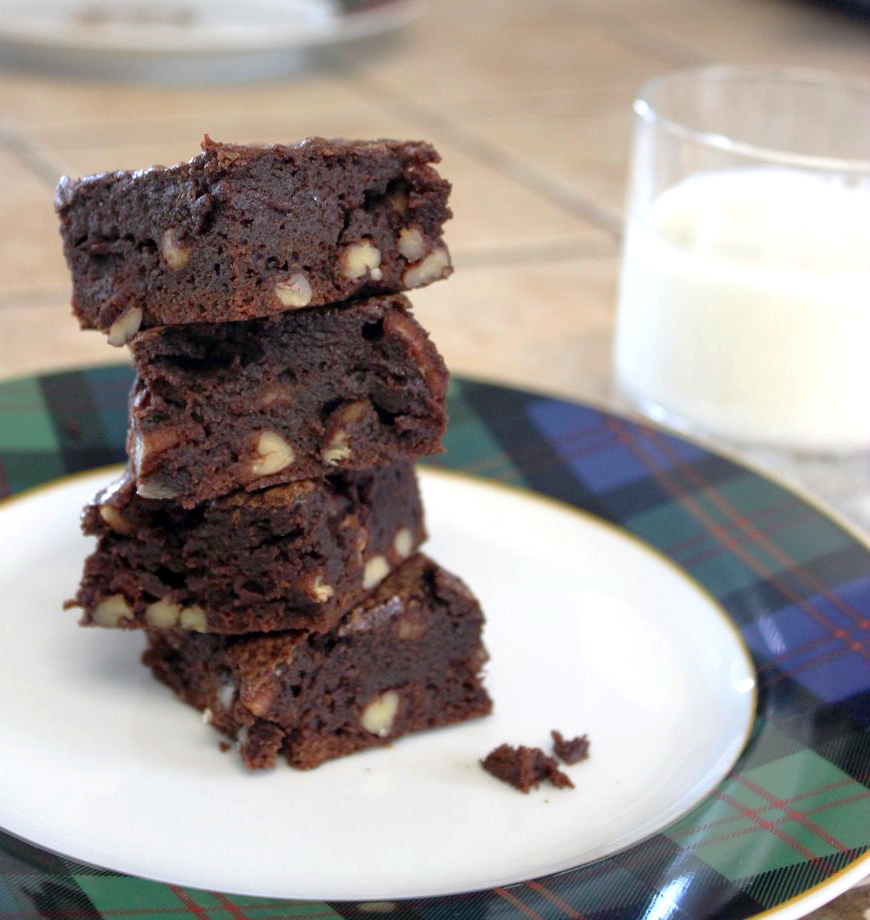
I was warned that I would eat the entire tray

I cut the original recipe’s sugar down a bit, but not enough to change the consistency of the batter.  I also substituted pecan pieces for the original recipe’s walnuts, and ended up having to add 15 minutes to the original recipe’s baking time.

Browned butter brownies

Recipe adapted from the Bon Appétit recipe for Cocoa Brownies with Browned Butter and Walnuts

Print recipe

Ingredients

  • Nonstick vegetable oil spray
  • 10 tablespoons (1 1/4 sticks) unsalted butter
  • 1 cup sugar
  • 3/4 cup natural unsweetened cocoa powder (spooned into cup to measure, then leveled)
  • 1 teaspoon vanilla extract
  • 2 teaspoons water
  • ½ teaspoon salt
  • 2 large eggs, chilled
  • 1/3 cup plus 1 tablespoon all purpose flour
  • 1 cup pecan pieces

Directions

  1. Preheat oven to 325 degrees F.  Line an 8”x8”x2” pan with aluminum foil, allowing the foil to hang over the edges of the pan by about 1 inch.  Coat the foil with non-stick cooking spray.
  2. Melt butter in a medium saucepan over medium heat.  Stir constantly for about 5 minutes and remove from heat when butter stops foaming and small browned bits begin to form on the bottom of pan.
  3. Immediately add the sugar, cocoa powder, vanilla extract, water and salt.
  4. Allow mixture to cool for 5 minutes.  Then add eggs, one at a time, stirring until each is combined into the batter.
  5. Add the flour and stir until combined, about 80 strokes.
  6. Add the pecan pieces, and pour into pan.
  7. Bake about 40 minutes, until toothpick inserted in center comes out nearly clean (with only a few crumbs attached).
  8. Allow to cool in the pan, and remove by lifting the sides of the foil.  Cut into 16 squares.  Store airtight at room temperature.

Verdict: I did not eat the entire tray.  I ate three brownies; two right after the batch came out of the oven when the brownies were still warm and gooey, then one later once they had cooled (I had to make sure the final result was the correct consistency, right?)  The brownies were excellent, and now I can never go back to making brownies from a box.  They were that good.

As promised, they were the perfect blend of crispy top and fudgy center.  But the brownies were so rich and chocolatey, I don’t think I could have eaten the whole tray if I tried.  It was like my daily lunchtime dessert of one Dove dark chocolate square—satisfying, and just the right amount.  Unlike milk chocolate which just leaves me wanting more, the brownies were like the dark chocolate in that one small serving satisfied my chocolate craving.  Lucky for me (and everyone else with whom I could now share the brownie tray), I was more in danger of finishing the entire carton of milk.

Nypon Soppa, or Swedish Rose Hip Soup

19 Jan

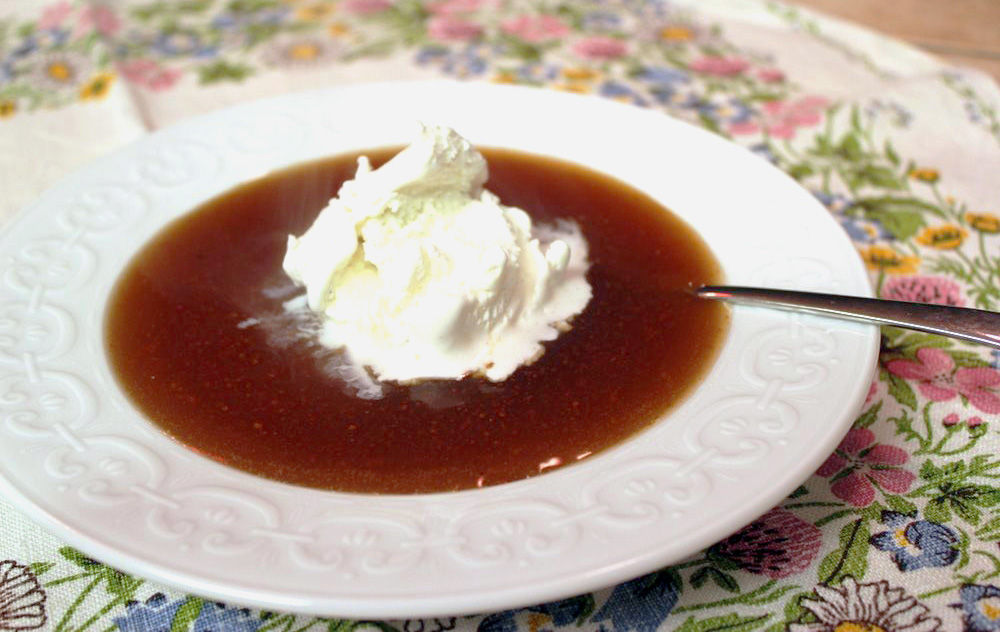
Nypon soppa is a Swedish dessert soup/drink made with rose hips and typically topped with vanilla ice cream, whipped cream, or vanilla sauce (vaniljsås).  It’s a dish that brings me instantly back to childhood, when my mom and I could whip up a batch in an instant thanks to the boxes of mix my aunt would send us from Sweden.

The ingredients in nypon soppa are minimal, and yet the fragrant smell of the rose hips can immediately conjure up an image of an abundantly green Swedish forest in summer, full of wild-growing fruits.  With melting ice cream on top, the perfect spoonful combines both the hot floral soup with cool, creamy vanilla.

http://en.wikipedia.org/wiki/Rose_hip

Wikipedia photo

Key among nypon soppa’s few ingredients are rose hips, which are the fruit of the rose plant that form after the flower has bloomed.  The seeds inside are used to grow a new rose plant, but whole rose hips including the seeds are also used in a variety of other applications including herbal remedies, teas, desserts and drinks. (see Wikipedia entry on rose hips)

Ekströms is a leading brand that makes both instant and premixed refrigerated versions of nypon soppa. (Think the Scandinavian version of instant Jell-O pudding, as far as ease and popularity.)  Every so often I see the box version (in which you just add hot water) at IKEA, but it’s been a while, and I’m guessing probably not one of their top-selling items.

To those who didn’t grow up eating it, it may both sound strange and taste stranger on the first sip.  Jan thought the mixture tasted like pure herbal tea when he first tried it, though an increase in the ice cream-to-soup ratio quickly upped the dish’s standing in his mind.

Many years ago, when my mom and I had run out of box mixes, we successfully recreated a close relative of nypon soppa that was my childhood favorite: kräm.  Kräm is a thicker version (more like a pudding than a soup), more often made with strawberries or raspberries, heated, and topped with ice cold milk.  We made the pudding with fresh strawberries, sugar, and potato starch.  However, since potato starch isn’t always easy to find, we decided that corn starch could probably be used in its place.

Back to the present day and missing the familiar taste of nypon soppa, my dad set out to devise his own recipe.  Once the rose hips were sourced, it couldn’t get much simpler: add water, sugar and cornstarch, and then cook until thickened.

Rose hips can be purchased at Whole Foods, and more economically on Amazon.com.  You can by the flakes or the powder, as both have been made from dried rose hips.  With the flakes, you will have to grind them yourself, but you will be rewarded with a fresher taste (just like grinding your own spices).

At a recent family dinner, my dad prepared nypon soppa for both sides of the family (except for Jan, all of Jan’s side had never had it before).  After one bite, my father-in-law was quickly reminded of picking rose hips in the Czech Republic many years before. Despite the taste being different from the usual dessert, he gave it his full approval, as did everyone else.

Nypon soppa

Print recipe
Ingredients

  • 1 quart water
  • 3 tablespoons rose hip powder
  • 6 tablespoons corn starch
  • 6 tablespoons sugar

Directions

  1. Grind rose hips into a fine powder using a spice grinder and measure out 3 tablespoons.
  2. Combine ground rose hips with sugar and starch.
  3. Pour into a saucepan that has been filled with cold water and stir until dissolved.
  4. Heat over low to medium heat until mixture thickens, about 10-15 minutes.
  5. Pour into bowls and serve hot, topped with vanilla ice cream.

Cornbread and Chili

13 Jan

With gray skies outside and only a few days of sunshine peeking through every so often, it’s been a couple of weeks for stews, soups, and chili.  Since everyone seems to have their favorite winning chili cook-off recipe, I’m starting out with cornbread, since for me, chili without cornbread is like a hamburger without a bun, apple pie without vanilla ice cream, cereal without milk; it just won’t do.

I’ve tried a variety of cornbread recipes ranging from the one on the cornmeal package to the recipes from several books, and it’s one of the simplest breads to make.  There are no critical times for resting dough, babying yeast, and too-early opening of the oven door, and therefore, perfect for me. Cornbread’s straightforward ingredients and process make it generally foolproof.  Its simplicity has provided the perfect jumping off point for experimentation, especially when I’m missing an ingredient or two.  One day I ran out of all purpose flour and substituted some whole wheat flour and a little more corn meal.  No problem!  It tasted great, and we enjoyed more rustic-looking bread, as the color was earthier, instead of the usual bright yellow.

Another time I ran out of sugar, and I used honey instead to another successful result, of course, with the distinctive flavor of honey.  I’ve been curious to make it with fresh corn kernels, but haven’t since Jan has voted against it—that may go over OK at Sweet Tomatoes, but he wants his cornbread smooth.

My current recipe is a result of several experiments, with the understanding that there will be more experimentation in the future, depending on what my pantry may be missing that day.

Cornbread

Print recipe

Ingredients

  • ½ cup all purpose flour
  • ½ cup whole wheat flour
  • ¾ cup cornmeal
  • 1 tablespoon sugar
  • 1 tablespoon honey
  • 1 tablespoon baking powder
  • 1 teaspoon salt
  • 1 egg
  • 2/3 cup milk
  • 1/3 cup vegetable oil

Directions

  1. Preheat oven to 425 degrees F.
  2. Grease a 8”x8” pan with butter.
  3. Mix together dry ingredients in a bowl.
  4. In a separate small bowl, combine the wet ingredients, then add to dry ingredients.
  5. Bake 25 minutes until golden.

Snow-Capped Macaroons and Mountains

5 Jan

Ever since I made the German chocolate cupcakes for our Noktoberfest party (see post Lederhosen and Lebkuchen), I’ve had an abundance of sweetened shredded coconut in my pantry. Since I’m not usually a fan of coconut and the shredded coconut isn’t a regular pantry staple at our house, I’ve been looking for something else to make with all the leftover coconut besides simply making the German chocolate cupcakes again (which was tempting since they were pretty tasty).

And then I came across these Snow-Capped Macaroons on The Bitten Word made from this Food Network Magazine recipe. The cookies looked simple and delicious, and I already had the coconut so I was ready to go.

Too much coconut

Besides, I was inspired by all the snow we were getting in the Sierras and knew it would mean even more great skiing in the days to come. Jan and I already had a few good cross-country and downhill ski days in, and with all the new snow, I knew there would be plenty more in the future. Making cookies that resembled the snowy peaks seemed like the perfect way to welcome more snow.

To make the cookies, I beat egg whites until frothy, added sugar, chopped almonds, vanilla, salt, and the shredded coconut. Atop my new favorite kitchen tool the Silpat mats, I used a tablespoon to measure out the cookie mounds. Then, after dampening my fingers with water, I formed the mounds into little cones.

I baked the cookies until they started to turn golden brown at the edges. After cooling, I used a double-boiler to make the chocolate glaze, and slowly dripped the glaze over the tops of the cookies. Lastly, I substituted the recipe’s sugar crystals for decorating, and instead used some sea salt crystals sparingly (the reason for this was twofold: I didn’t have sugar crystals and didn’t want to go to the store, and secondly, I tasted the cookie and glaze and thought adding even more sugar would make the cookie overly sweet. Thinking back to a holiday potluck I attended in which one person made surprisingly tasty bars with only Lay’s potato chips and white chocolate chips, I thought these cookies could also benefit from the salty/sweet combination. As I was experimenting, I left half the cookies plan with no salt/decoration, and did the other half topped with a few sea salt crystals. I used friends and family to taste-test the cookies side by side for the next few days, with the salt-topped cookies the clear winner over the plain ones.)

Mountains of snow!

Chewy but with a firm but flexible chocolate crust on the outside, the cookies tasted as good as they looked. Jan described them as tasting like a Mounds candy bar, so I was pleased.

The next day, I took some of the cookies in my backpack for another cross-country skiing adventure. Jan and I departed from the Tamarack Ridge Trailhead, about 10 miles north of Shaver Lake in the Sierra National Forest. Because the snow was fresh, deep and powdery, it wasn’t long before the groomed trail ended, and then after that, not even the snowmobiles could traverse the trails. So, about mid-thigh deep in snow, we made the path that looped back to the trailhead ourselves, and it was certainly a workout. But being out in the forest, hearing only the sounds of snow crunching under our ski poles, the beauty and serenity we were able to experience was worth the work. When I remembered it was time for a snack, the Snow-Capped Macaroons were just the thing to keep us going for the rest of the miles.

Skiing snack time

Snow-capped macaroons

Print recipe

Ingredients

Cookies

  • 2 large egg whites
  • ½ cup granulated sugar
  • ½ cup sliced almond slivers
  • ½ teaspoon vanilla extract
  • ¼ teaspoon salt
  • 3 cups sweetened shredded coconut

Glaze

  • 6 ounces semisweet chocolate chips
  • 3 tablespoons corn syrup
  • 1 tablespoon butter
  • Sea salt crystals, for decorating

Directions

  1. Preheat oven to 325 F degrees.
  2. Line 2 baking sheets with parchment paper or silicone mats.
  3. Lightly beat egg whites in a medium bowl until frothy. Stir in sugar, almonds, vanilla and salt, then fold in coconut.
  4. Use a tablespoon to drop batter into mounds 1 inch apart. Dampen hands with water to form into pointed mounds.
  5. Bake until edges are golden brown and the edges look dry, about 16-20 minutes.
  6. let cool 10 minutes on the baking sheets before transferring to a baking rack to cool completely.
  7. Make the glaze by using a double-boiler to melt chocolate, corn syrup and butter together.
  8. Use a spoon to drizzle the glaze over the tops of the macaroons, so that it drips down the sides in several directions.
  9. Sprinkle the tops sparingly with sea salt crystals.
  10. Refrigerate until the glaze sets, about 1 hour. Store in an airtight container up to one week. Makes 36 cookies.
Follow

Get every new post delivered to your Inbox.

Join 165 other followers