It hasn’t been dinner as usual at the Our Life in Meals household recently. During the past few weeks, Jan sent me updates (and photos) of various barbecue eaten across the Southwestern United States as he fought forest fires in Texas and Arkansas (driving there and back and seeming to stop at every barbecue joint along the way). Needless to say, I’ve gone through a few rotisserie chickens and boxes of cereal (not for the same meal, of course) while he was gone.
And because I’d let several weeks go by without posting to Our Life in Meals, the harder it became to begin again. Even once Jan returned home, I felt that we had to prepare some amazing meal for me to break the ice.
But it turned out that a seemingly standard dinner might do the trick when Jan and I combined our heritage to prepare one of the best meals we’ve had in months. Continue reading →
It seems that everyone has a cake they prefer to get on their birthday, and in our family, it’s come down to two frontrunners, one a flashy store-bought treat, the other a homemade favorite. In one corner, we’ve got what we call the “choo-choo-train cake” from Baskin Robbins. Many of you might remember this cake from your childhood: chocolate cake and ice-cream (usually strawberry or vanilla flavor) rolled into a cylinder and decorated to look like a train. Large cookies form the wheels, an upside-down cone forms the smoke stack, and the rest of the details are created with large quantities of frosting. Continue reading →
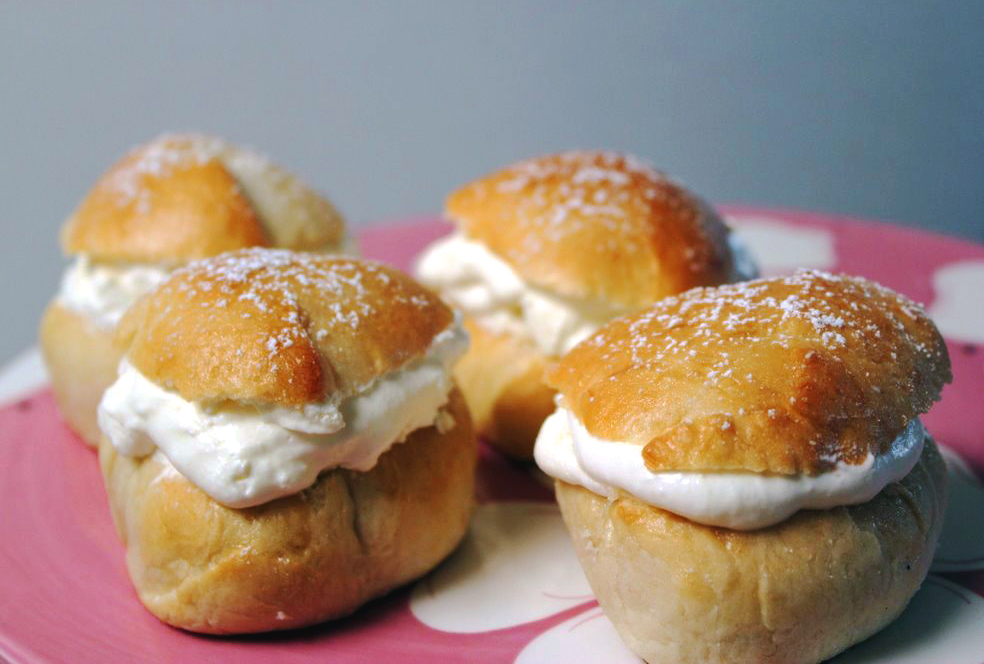
If a dish has the word “fat” in the title, you know it’s got to be good. Granted, in the case of Fat Tuesday Buns, the reference is to Fat Tuesday, a day allocated to gluttony and overindulgence, not the bun itself, but this Swedish treat still lives up to its name.
When you bite into a Fat Tuesday Bun, you will inevitably get whipped cream everywhere. But the messiness makes it better. And finally, after one disastrous attempt at making this dish last week, I achieved Fat Tuesday Bun success!
The first time around, I just couldn’t get anything right. I’m still working on perfecting my recipe, but here’s what I did, just in time for Fat Tuesday (coming up next Tuesday, March 8).
Fat Tuesday Buns, or Semlor as they’re called in Sweden, are cardamom-spiced rolls filled with whipped cream and almond paste. As a kid, the cardamom flavor was too strong for me, so my mom and I made plain rolls and followed the rest of the recipe. I have a feeling that as an adult, (and the much more open-minded about different flavors person I’m slowly becoming,) I would probably feel less strongly about the cardamom as I did with my young taste buds. But considering the baking disasters of last week, I didn’t want to take too many chances. I thought, this time, I’ll make it the plain, old way, and do more experimenting on the next go around.
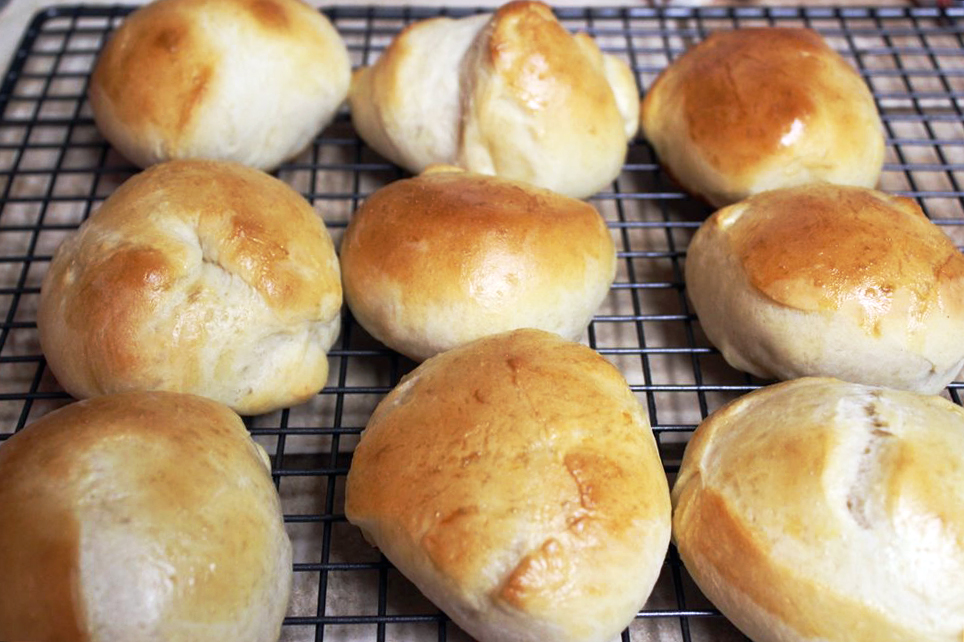
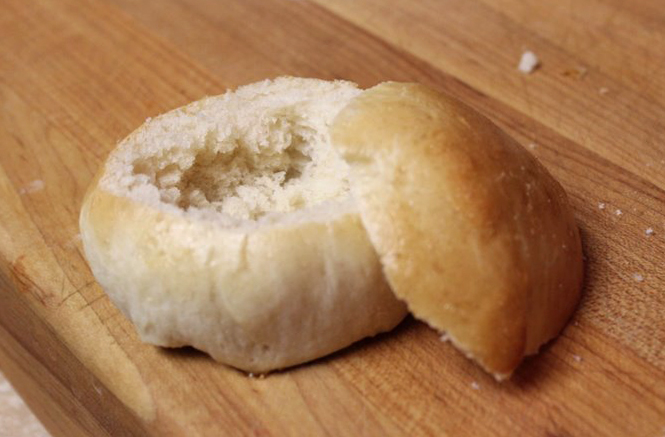
I used a recipe for plain dinner rolls from my Better Homes and Gardens cookbook. I’m thinking that even the Pillsbury Crescent rolls should work well as another shortcut. Just before putting the rolls in the oven, I brushed the tops of the buns with egg to make they would have that beautiful, golden crust on the top. After baking and allowing to cool slightly, I cut the tops off the buns, making sure to keep the matching top with its corresponding bottom. I scooped out the inside of the rolls, leaving a little less than ½” around the sides and bottom (think mini bread bowl). Putting the scooped-out bread in a bowl, I moistened that with milk and combined with almond paste (you can also use marzipan, the outcome will just be sweeter).
Plain buns just out of the ovenPrepped and ready for filling
The filling went back into the hollowed-out buns, which were topped with whipped cream I sweetened with powdered sugar. Each bun’s top was then placed atop the whipped cream, and the bun got a sprinkling of powdered sugar. I didn’t wait long to take my first bite, but the remaining buns kept well in the refrigerator for several days. After enjoying this batch that stayed true to my memories from childhood, I’m ready to try making the more authentic cardamom version next.
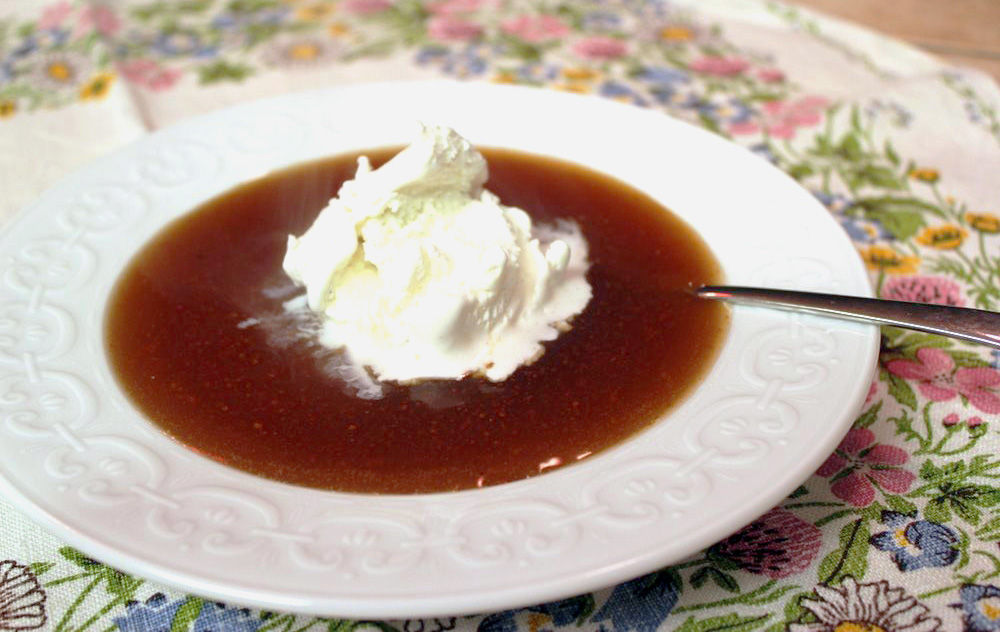
Nypon soppa is a Swedish dessert soup/drink made with rose hips and typically topped with vanilla ice cream, whipped cream, or vanilla sauce (vaniljsås). It’s a dish that brings me instantly back to childhood, when my mom and I could whip up a batch in an instant thanks to the boxes of mix my aunt would send us from Sweden.
The ingredients in nypon soppa are minimal, and yet the fragrant smell of the rose hips can immediately conjure up an image of an abundantly green Swedish forest in summer, full of wild-growing fruits. With melting ice cream on top, the perfect spoonful combines both the hot floral soup with cool, creamy vanilla.
Wikipedia photo
Key among nypon soppa’s few ingredients are rose hips, which are the fruit of the rose plant that form after the flower has bloomed. The seeds inside are used to grow a new rose plant, but whole rose hips including the seeds are also used in a variety of other applications including herbal remedies, teas, desserts and drinks. (see Wikipedia entry on rose hips)
Ekströms is a leading brand that makes both instant and premixed refrigerated versions of nypon soppa. (Think the Scandinavian version of instant Jell-O pudding, as far as ease and popularity.) Every so often I see the box version (in which you just add hot water) at IKEA, but it’s been a while, and I’m guessing probably not one of their top-selling items.
To those who didn’t grow up eating it, it may both sound strange and taste stranger on the first sip. Jan thought the mixture tasted like pure herbal tea when he first tried it, though an increase in the ice cream-to-soup ratio quickly upped the dish’s standing in his mind.
Many years ago, when my mom and I had run out of box mixes, we successfully recreated a close relative of nypon soppa that was my childhood favorite: kräm. Kräm is a thicker version (more like a pudding than a soup), more often made with strawberries or raspberries, heated, and topped with ice cold milk. We made the pudding with fresh strawberries, sugar, and potato starch. However, since potato starch isn’t always easy to find, we decided that corn starch could probably be used in its place.
Back to the present day and missing the familiar taste of nypon soppa, my dad set out to devise his own recipe. Once the rose hips were sourced, it couldn’t get much simpler: add water, sugar and cornstarch, and then cook until thickened.
Rose hips can be purchased at Whole Foods, and more economically on Amazon.com. You can by the flakes or the powder, as both have been made from dried rose hips. With the flakes, you will have to grind them yourself, but you will be rewarded with a fresher taste (just like grinding your own spices).
At a recent family dinner, my dad prepared nypon soppa for both sides of the family (except for Jan, all of Jan’s side had never had it before). After one bite, my father-in-law was quickly reminded of picking rose hips in the Czech Republic many years before. Despite the taste being different from the usual dessert, he gave it his full approval, as did everyone else.
Cheese and crackers aren’t supposed to be exciting. But call it a Smörgåsbord and suddenly, Jan and I are in. It’s the go-to supper when we don’t really feel like cooking or going out. But it’s also not the meal to make if we’re feeling lazy either, as we typically spend a good deal of time slicing every type of meat or cheese currently in our refrigerator.
Growing up, the Smorgasbord was the typical Christmas Eve dinner in my family. In additional to meats, cheeses, crackers and breads, we’d add special items like smoked Salmon and homemade Swedish meatballs. We’d also make sure to have pickled herring on hand, which I loved as a kid, that is, before I realized that it was pickled fish swimming in a sour cream sauce. Though I went through many years disgusted by it, I’m now slowing letting the little jar back into my life.
And now, even minus the excitement of impending Christmas-present-opening, this dinner is so much fun. Maybe because we have a soft spot for the appetizers-for-dinner meal, or creating each little bite at the table makes us take our time enjoying dinner. I think the best part is trying different combinations and determining the best.
Clockwise from top: spreadable Port cheese, blue cheese, Gruyere, Dubliner, Muenster, double-cream Brie, and Swiss in the center
This last time, Jan raved about the prosciutto paired with aged Parmesan, while I was smitten with the Black Forest Ham and Swiss Cheese on Black Rye bread. While Jan got creative with his presentation, drizzling balsamic vinegar over a log of goat cheese and sprinkling chopped fresh basil on top, I took it one step further and spread this mixture on a slice of Granny Smith apple for a surprisingly tasty combination.
While some items make it back for another Smorgasbord dinner, each of these meals is never the same, and maybe that’s why it’s so exciting. Something traditional and simple can sometimes lead to innovation, if we’re willing to try something new.
 It hasn’t been dinner as usual at the Our Life in Meals household recently. During the past few weeks, Jan sent me updates (and photos) of various barbecue eaten across the Southwestern United States as he fought forest fires in Texas and Arkansas (driving there and back and seeming to stop at every barbecue joint along the way). Needless to say, I’ve gone through a few rotisserie chickens and boxes of cereal (not for the same meal, of course) while he was gone.




 Our Life in Meals