Seems like I’ve been hearing about quinoa everywhere lately, so realizing I’m probably far behind the times, I decided it was finally time to give it a try. A staple food in South America, quinoa (“keen-wah”) is a grain known for its high protein content. It can be used as a side dish, where rice or pasta might ordinarily be used, or cooked as a part of the main meal.
We found a box of organic quinoa at Trader Joe’s and cooked it according to package directions. Instructions stated that it could be cooked in rice or broth, and we used chicken broth, since we figured that would give the grain a greater depth of flavor. Continue reading →
A few years ago, when Jan and I first moved into our house from our apartment, our new kitchen seemed like a vast amount of space in which we’d never run out of room for plates, pots and pans, kitchen tools, and gadgets. Moving up from a tiny galley kitchen into a space with more than two under-counter cabinets, three wall cabinets, and two drawers, this feeling lasted for a while. But then, the inevitable happened, I began using the hall closet as our overflow pantry, storing “fancy” glassware, infrequently used roasting pans, a dutch oven, miscellaneous utensils, and a growing collection of kitchen gadgets. Then, after this space got full, a shelf in my office became dedicated to a varied collection of plates and serving dishes.
For about a year, I moved a large rotisserie oven from space to space in an effort to find a suitable location for it to be stored. Not once in this period did we use the gadget. Finally, we found a friend who was thrilled by the idea of making his own rotisserie chickens, and I was thankful I could reclaim those precious cubic feet in the closet. Continue reading →
So much tiling, so much corned beef! Phew! Last week was exhausting! With so much going on, Jan and I needed some delicious, quick, and easy-to-prepare food.
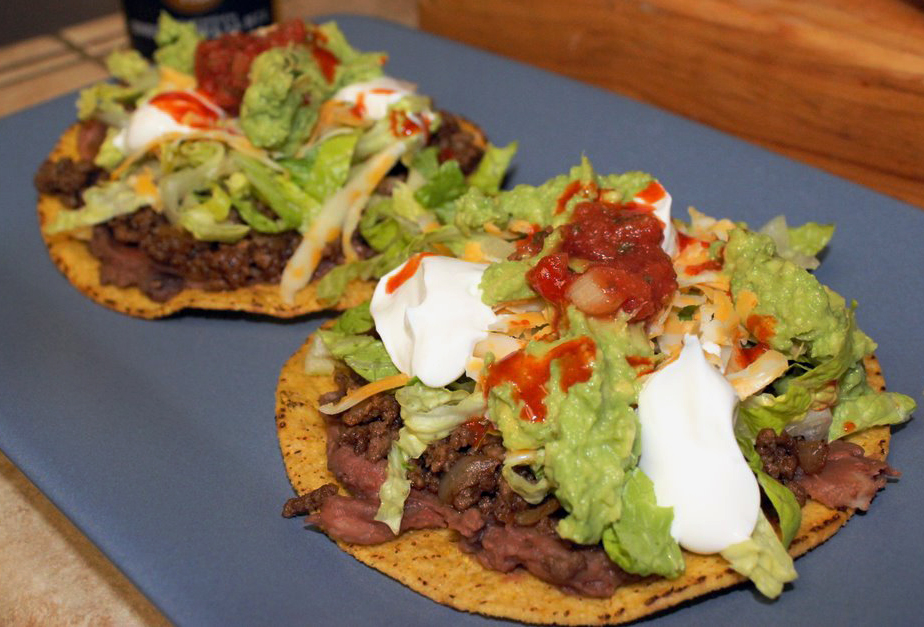
Enter the tostada dinner, an amazing meal that requires minimal time and effort. When Jan brought home tostada shells (shortcut #1), we took a few more shortcuts to cook up a batch of tostadas in a matter of minutes. It was such a surprisingly tasty dinner that we ate the same meal twice in the same week.
I started by sautéing some onions in a little bit of oil in a pan. Once the onions started to become translucent, I added ground beef (didn’t grind our own this time, so shortcut #2) and spices to make my own blend of taco seasoning. The blend included garlic powder, California chili powder (it’s not too spicy, but gives you that great reddish-brown color usually only achieved by pre-mixed taco seasoning), cumin, oregano, chili flakes, and salt. I combined the meat with the spices, added a few tablespoons of water, and cooked over medium heat.
While the meat was cooking, I began heating up the beans (shortcut #3 is canned beans. Jan prefers the refried beans while I prefer black beans, so we compromise by alternating which one we choose.)
This is also the time to start getting all the toppings ready, so we finely chopped lettuce or green cabbage (we usually stick with iceberg lettuce for beef tostadas or tacos, but use green cabbage on occasion, and definitely when making fish tacos). We also got out sour cream and salsa from the refrigerator to add to our tostada-assembling station. We shredded some Colby Jack cheese and made guacamole from a fresh avocado (there’s room for another shortcut here if you use the pre-made guacamole, I recommend both the Trader Joe’s and Costco varieties). The last piece was the Tapatio.
Ingredients prepped, tostadas ready to assemble
Once the meat was done and beans were heated, it was time to assemble the tostadas. Atop the shell, I started with the beans, then added the meat, then the lettuce and the rest of the toppings. Inevitably, my tostadas were overloaded, and I had to break out my fork. Then I enjoyed my tostadas and debated when I should tell Jan about his sour cream mustache (think milk mustache, but thicker). In the meantime, we reflected on a successful corned beef and cabbage celebration.
Our first guest to arrive found a four-leaf clover in our front yard walking up to the front door (unfortunately I didn’t capture a picture of our good luck charm, but thanks to a lovely thank-you note from my friend Sarah, I have an image that looks pretty close to the original).
Jan cooked the massive amount of corned beef in a 15 gallon pot outdoors, and it was enough to fill one 2-foot by 1-foot wide chafing dish. Our other full-size chafing dish was filled with green cabbage and potatoes. I was amazed that everything was eaten pretty quickly—either everyone was starving, or the food was pretty good!
Despite both the orange of my carrot cake cupcakes not being the orange I desired, nor the green cream cheese frosting (I was going for the orange and green of the Irish flag but instead got the two unappetizing colors of rust orange and Easter egg green), those all got eaten too. And lastly, for those dying to see what all the fuss over the tiled floors was about (see last week’s Prepping for St. Patrick’s Day), a picture of the newly installed tile.
For the moment, we’re taking at least a month’s break from tiling and large-scale entertaining. We’re going to be lazy for a while. Good thing we discovered the perfect lazy-night dinner. I have a feeling we’re going to be eating a lot of tostadas.
If someone questioned our sanity right now, I wouldn’t blame them. About a month ago, Jan and I began a serious home-improvement project. Fed up with carpet and linoleum that didn’t stand up to our frequent entertaining and furniture re-arranging, we opted for one of the most durable and low maintenance flooring surfaces we could find: porcelain tile. With the goal to replace all the floors in our house with beautiful 18”x18” tiles, we began in the living room/hallway/dining room, since all the other rooms in the house branched from that central axis.
Gung-ho to complete the project ourselves, we delved right in, and since Jan had installed tile before and I’d installed laminate flooring, we had great confidence in our ability to get it done quickly and efficiently.
The tiling was a lot more work than we’d anticipated, and a month into the project, it still feels like we’ve only just begun. We started with enthusiasm, but after working at our jobs all day, it was difficult to get motivated to come home only to do some seriously strenuous physical labor. In addition, as I’m sure many can relate, working harmoniously on a DIY project with your significant other is one of the biggest challenges a person can undertake. While well-meaning friends shared statistics in jest about DIY projects being a contributing factor in many a divorce, I started to wonder if there was more merit to the numbers than I’d previously thought.
Choices, choices, choices. Tile, or relax? Spend the evenings and weekends happy and peaceful, or engaged in a heated debate over the “levelness” of one particular tile? The project didn’t always win out.
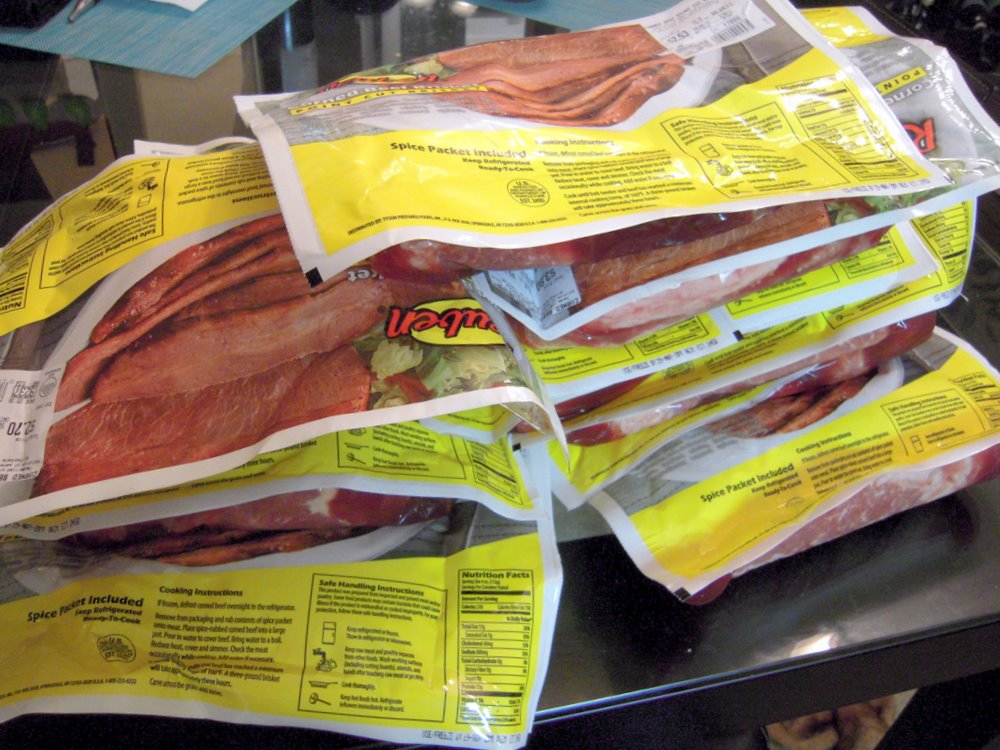
But sometimes the only way to get things done is with a deadline, and we definitely had one looming. Hosting a big celebration for St. Patrick’s Day has started to become a tradition at our house. Right around this time, Jan gets excited and antsy, scanning the grocery store ads for the exact moment when corned beef goes on sale for $1/pound. Last year, Jan cooked 10 pounds of corned beef on St. Patrick’s Day, and last week, he came home with 33 pounds of corned beef ($.99/lb at Fresh and Easy, and with the “Limit 2 per customer” difficult to enforce at a store that only employs self checkout lines, Jan may have gone overboard.)
Mountains of corned beef
With guests expected to help eat the corned beef, I knew we couldn’t welcome them into a halfway-tiled space they had to tiptoe over. The corned beef would make us finish, whether we wanted to or not.
Corned beef and cabbage used to be one of those things I liked to have once a year, and once a year only. You wouldn’t catch me thinking, hmm, I’m craving corned beef and cabbage for dinner (like Jan does). But it might be one of those dishes that grow on you. I’m starting to think I could have it about twice a year and be OK.
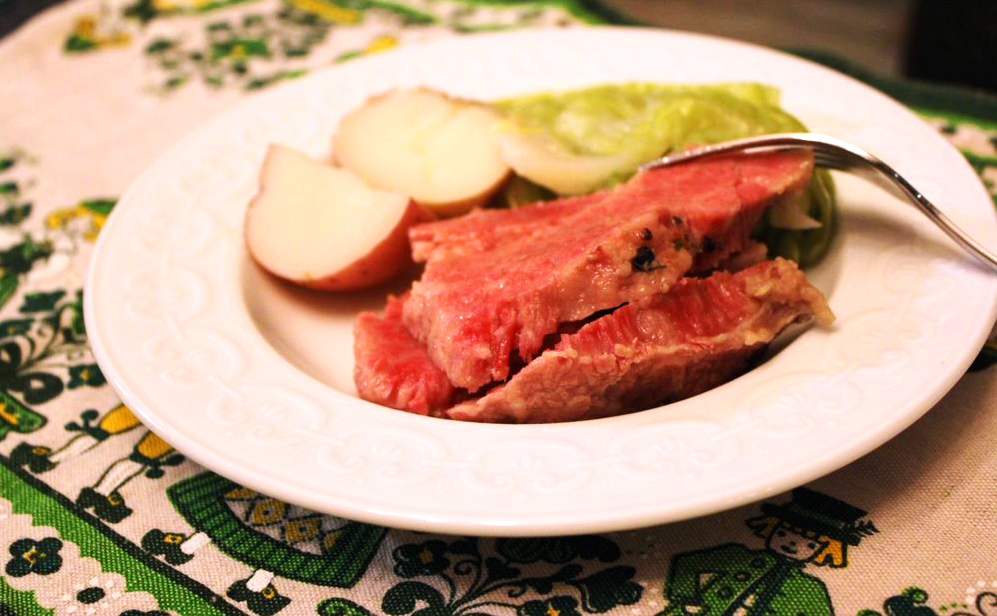
Good thing too, since Jan was so excited to celebrate, he decided to do a test run of the corned beef and cabbage. Besides, it was a welcome break from tiling, and with our approaching deadline, we were actually making good progress. We opened up one of the packages and after trimming off as much fat as we could, cooked according to the package directions using the included spice packet. The general rule is to cook for one hour per pound, adding the cabbage and potatoes in the last half hour of cooking.
Green cabbage, corned beef, and red potatoes
To wash it all down, we made Black and Tans, using Guinness Draught and Harp Lager. To prepare, we filled the glasses about 1/2 of the way with the light colored beer (Harp Lager), then poured the dark beer (Guinness Draught) over an upside-down spoon to fill the remainder of the glass without splashing and mixing the two layers.
Pour the Guinness over the Harp LagerMuch-needed refreshment
We sat together in the hallway (dining table moved there in order to tile the floor of the dining room), eating our corned beef, sipping the beer, and admiring our newly laid tile.
“It looks so good, I think it was worth it,” Jan said. I gave him a sideways glance. “Worth the amount of work, and worth almost getting divorced,” he said with a smile.
I had to agree with him. It did look great. In retrospect, it wasn’t that bad. Apparently we agreed on more things than we thought, including that the corned beef and cabbage was delicious.
While we might have only completed a fraction of our big project, and probably won’t lay another tile for another six months, we’ve got everything we need: a completed dining room, a completed living room, and 31 pounds of corned beef.
I had a disheartening day of baking. (Note: if you just want to hear the crab legs, skip to the last paragraph of this post. Keep reading to see why the simplicity of boiled crab legs is sometimes the only answer.) I thought I would be brilliant and make Czech Kremrole, a cream-puff-type dessert Jan has been talking about wanting to eat for months. I found a recipe in my Czech cookbook and Googled Kremrole, to see what the dish should look like. I made a trip to Sur La Table to get stainless steel cannoli tubes around which I would wrap pastry dough, bake, then fill with whipped cream and top with powdered sugar.
It didn’t seem too tough, until I realized the dough the recipe book called “puff paste” was the painstakingly made puff pastry. But I was determined to make these treats for Jan. I made my two doughs, the butter dough and the strudel dough, and followed the tedious steps of folding the butter dough into the strudel dough, folding in thirds, thirds again, and refrigerating for an hour. Three times I did this rolling-out, folding into thirds then thirds again, then refrigerating. When it was time to wrap the dough around the tubes, everything looked beautiful as I placed them in the oven.
Despite following each of the recipe’s steps, the Kremrole was a disaster—the butter was literally melting off the dough and pooling in the baking sheet. I can’t even share a picture, it’s just too sad to show. To make matters worse, I realized I could have just bought premade puff pastry earlier in the day at the store. But of course, that was before I read through all the recipe steps, experienced it firsthand, and now know that puff pastry is not something for the amateur to attempt at home (or else something that takes a lot of practice to master).
I thought I could save the day by making something else that involved filling a pastry with whipped cream, something I was craving, and that I’d made many times before. Semlor, or Swedish Fat Tuesday Buns are the Swede’s version of indulgence before Lent, something my mom and I used to make every year around this time of year. They are basically a cardamom-spiced sweet roll that has been filled with marzipan and whipped cream, and I thought I could redeem my failed cream rolls with a successful batch of Fat Tuesday Buns.
I baked the buns, no problem. I cut the tops off the buns, removed the inside, and got to work making the filling. Only problem was, I was distracted and grabbed the container of what I thought was powdered sugar in the pantry. When I tasted my whipped cream to see if I’d achieved the correct level of sweetness, I knew something was terribly wrong. It was then that I turned the container around to read the dreaded words: corn starch.
It was just not my day. But then, as I too was about to turn into a sobbing mess of puff pastry gone melty and whipped cream gone chalky, Jan pulled out a 2 pound bag of snow crab clusters from Fresh and Easy. In a matter of minutes, he boiled the crab legs, boiled some shrimp, and boiled some corn on the cob. And the day was saved by Jan and a big boiled feast. I was so hard at work with the shell cracker, trying to get the crab meat out so I could squeeze lemon juice on it and dip into melted butter, all my baking problems faded away. Well, of course, after I strategized my game plan for reattempting those baking projects another day.
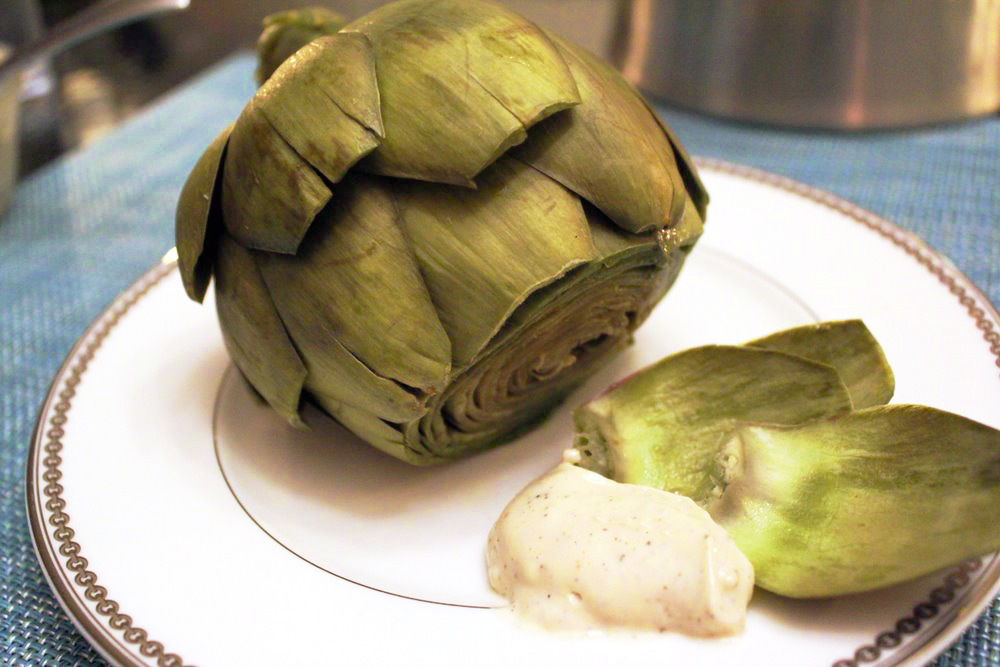
I’ve always loved artichokes. It may have something to do with the fact that any time I’ve eaten an artichoke, there’s always another rich ingredient involved, whether that’s mayonnaise, butter, oil, or cheese. Growing up, I dipped the leaves of the steamed artichoke in plain mayonnaise, scraping the soft bit at the bottom of the leaves with my teeth. At a friend’s, I ate grilled artichoke drizzled with lemon butter, at home, marinated artichoke hearts from a jar full of olive oil. And of course there’s always the wonderful spinach-artichoke dip that adds in cream cheese and Parmesan cheese.
But it’s not just the fattening toppings that make artichokes great. There’s something special about them—not only do they look unique, but the way they’re eaten is also unusual. Artichokes are thistles, plants whose flowers develop into large, edible buds. And the first person to figure out that this scary looking thing was edible? They were brave. I love the earthy flavor of artichokes, and after recently learning that they are full of fiber and antioxidants, I feel even better about eating them.
Last year we planted an artichoke plant in our garden, which produced one large artichoke and one mini artichoke. However, I left both on the plant too long, and they developed purple flowers at the top, becoming inedible. The master gardener at the Vineyard Farmer’s Market said this particular plant would bear three artichokes the first year, ten the next year, and possibly more in the years after that. With the plant now in its second year, I have high hopes for my ten artichokes (though they haven’t yet to make their appearance).
Artichoke growing in our garden
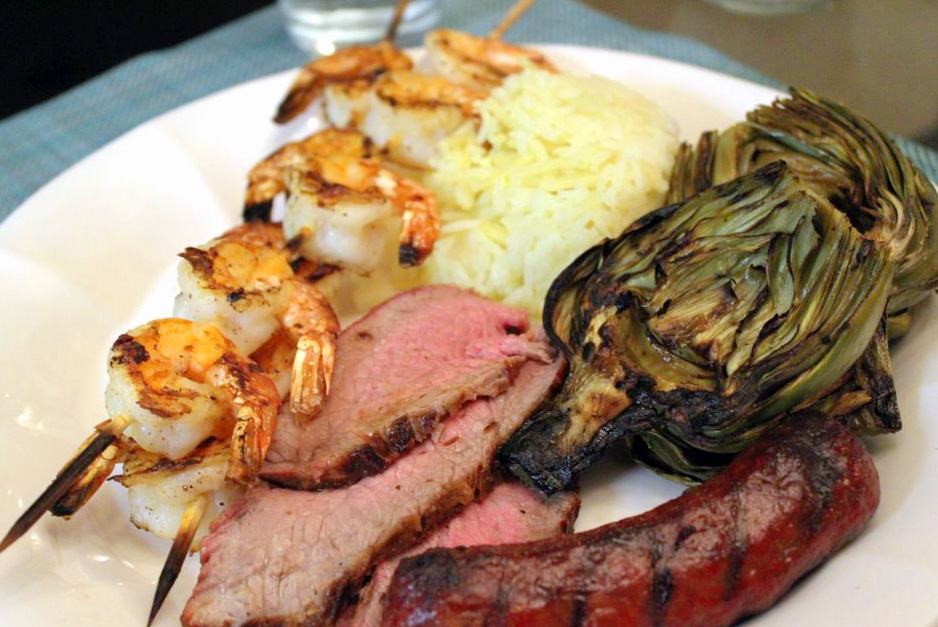
Though we’ve been using a gas grill for years, after the excellent dinner Jan cooked with an original Weber in Los Osos (see Favorite day in Morro Bay), he had to buy his own, and has been having fun lately using charcoal to barbecue just about anything. I was skeptical of the artichokes that had been steamed to cook about two-thirds of the way (about 30 minutes), then sliced in half and finished on the grill. But of course, they were excellent with the added flavor from the charcoal.
Great smoky flavor from the grill
Still, my favorite way to eat them is the simple way. I cut the stem to leave about an inch at the bottom, cut an inch off the top, and use scissors to cut the sharp points from the leaves. Then the artichokes are placed stem-side up in a steamer basket and left to steam for about 50 minutes. The artichokes are done when the lower leaves can be removed easily and are tender.
And continuing to keep things simple, the artichokes are served with balsamic-lemon mayonnaise, whose title reveals three of the sauce’s four ingredients. Despite all the delicious possible ways to eat an artichoke, in my opinion, this is the easiest and best.
Balsamic-lemon mayonnaise
To be served alongside steamed or grilled artichokes
A pizza pie, that is. We used to mostly just eat pizza at a pizzeria or out of a delivery box, but now with so many more options for ready-made crust, it’s become one of our favorite things to make at home. Before we discovered the refrigerated dough from Fresh and Easy, making pizza at home was this time-intensive process of making the dough, waiting for it to rise, and doing all this work before even getting to the fun part, which is putting on the toppings. It was always worth the effort, but one of those things we just didn’t do very often because of the time involved.
But now, skipping all those dough-preparation steps gets us to the part we like faster—putting on the toppings—which is probably why pizza has been on the menu every week for the past month. We’ve tried both the whole wheat and regular versions, and I think the regular dough comes out a bit crispier and crunchier (a good thing when making a thin crust pizza).
However, even though this pizza is easy, it’s not without challenges. After letting the dough sit out for about 20 minutes before rolling out onto a pizza pan or stone, we face our first dilemma: deciding which toppings to use. Our problem is that we always put on too much. I’m convinced that my beautiful thin crust can’t stand up to the mountain of toppings always covering it, but it seems to be working out ok. We bake the pizza longer than the suggested time of 10-15 minutes (about 20 minutes total) to get the crispy crust we like. So, for about 10 minutes of work and some waiting time, we’ve got a simple, delicious dinner.
After topping with tomato sauce and cheese, the last pizza included: turkey pepperoni, spicy pork sausage, red onions, black olives, red bell peppers, mushrooms, and artichoke hearts. You could hardly see the cheese underneath! Jan says you can’t have too much of a good thing, but I think our next challenge will be pizza topping editing—paring down to fewer ingredients to get the best balance of flavors. I’m always impressed by different and unusual combinations of toppings, but it’s hard to get out of our “combination” routine. What other favorite pizza topping combinations should we try next?
With gray skies outside and only a few days of sunshine peeking through every so often, it’s been a couple of weeks for stews, soups, and chili. Since everyone seems to have their favorite winning chili cook-off recipe, I’m starting out with cornbread, since for me, chili without cornbread is like a hamburger without a bun, apple pie without vanilla ice cream, cereal without milk; it just won’t do.
I’ve tried a variety of cornbread recipes ranging from the one on the cornmeal package to the recipes from several books, and it’s one of the simplest breads to make. There are no critical times for resting dough, babying yeast, and too-early opening of the oven door, and therefore, perfect for me. Cornbread’s straightforward ingredients and process make it generally foolproof. Its simplicity has provided the perfect jumping off point for experimentation, especially when I’m missing an ingredient or two. One day I ran out of all purpose flour and substituted some whole wheat flour and a little more corn meal. No problem! It tasted great, and we enjoyed more rustic-looking bread, as the color was earthier, instead of the usual bright yellow.
Another time I ran out of sugar, and I used honey instead to another successful result, of course, with the distinctive flavor of honey. I’ve been curious to make it with fresh corn kernels, but haven’t since Jan has voted against it—that may go over OK at Sweet Tomatoes, but he wants his cornbread smooth.
My current recipe is a result of several experiments, with the understanding that there will be more experimentation in the future, depending on what my pantry may be missing that day.
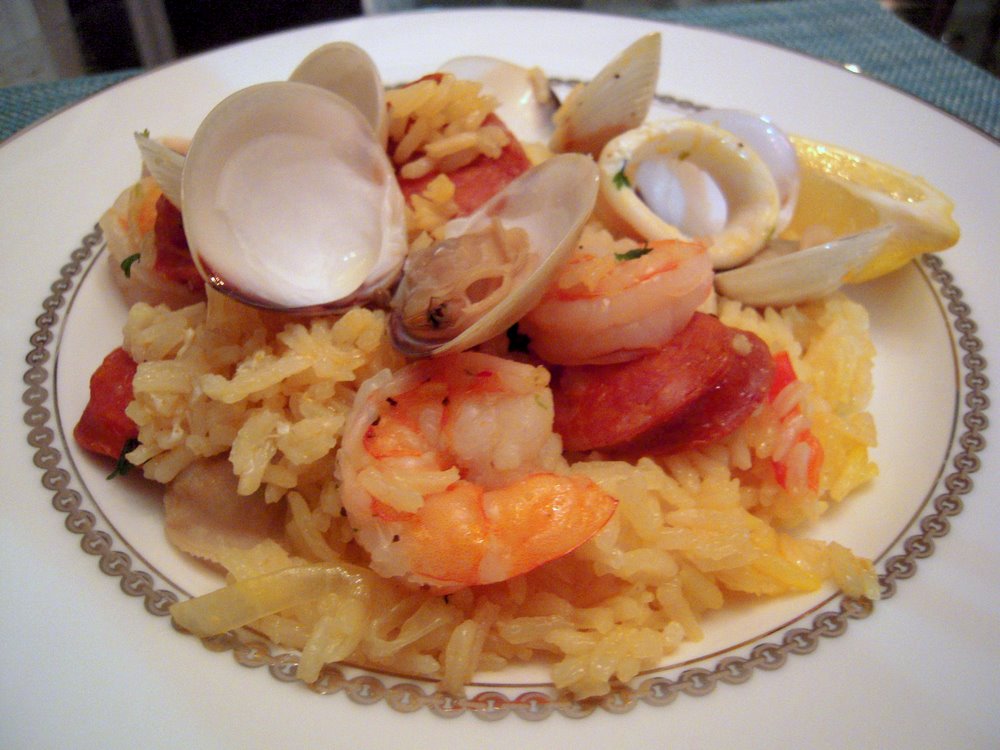
I had my first paella when I studied a semester in Spain, but it wasn’t until Jan saw it prepared multiple times on Top Chef that he quickly followed suit and we enjoyed this delicious dish together, many years later.
By now, Jan’s a paella expert, and he’s got his recipe perfected. Because the ingredients are basically mixed together and left to cook, following the proportions of rice and broth are important in creating perfectly cooked rice with a creamy consistency.
The concept of the dish is simple, and yet it makes for a sophisticated presentation. I’m always wowed by the aroma, the deep yellow color of the rice, and the abundance of seafood that seems to always be spilling over the pan.
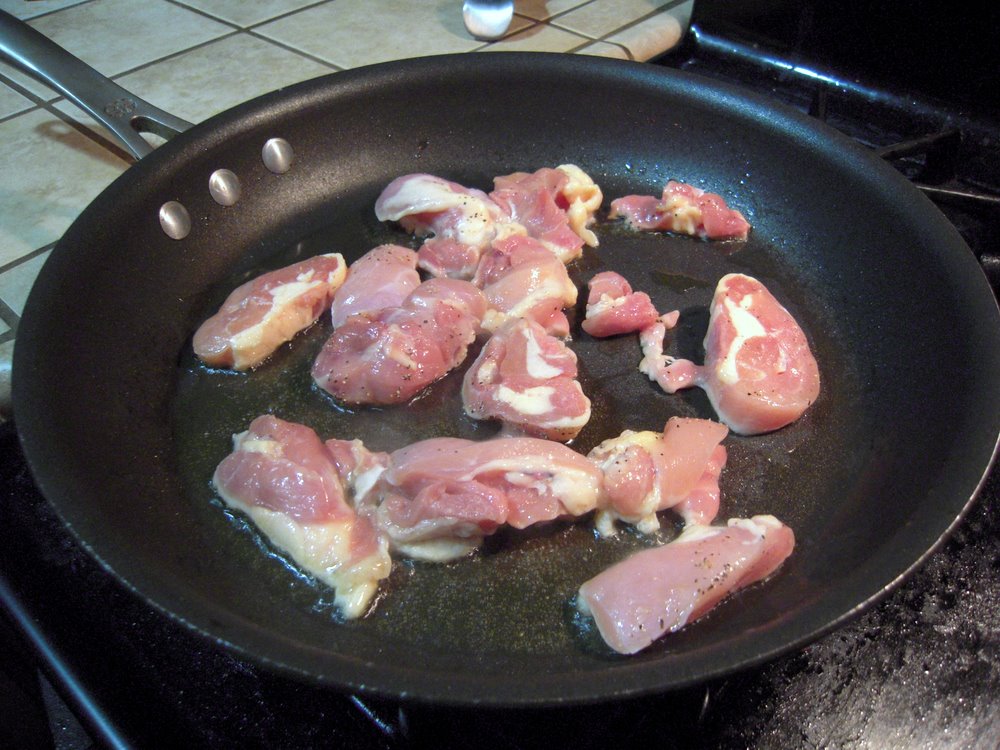
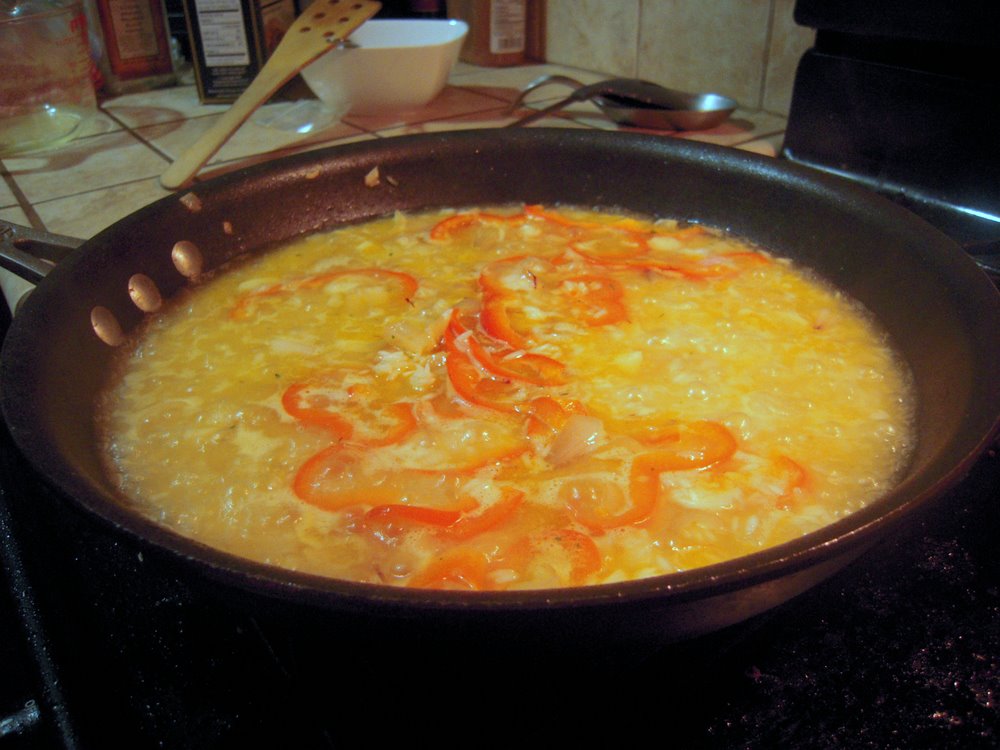
We’ve seen special paella pans marketed to chefs at cookware shops, but a large sauté pan with a lid will do the job equally well. We start by browning the chicken in the pan, removing, and browning onions, garlic and bell peppers. The rice is added, then the chicken stock, and placed in the oven to cook. After about 20 minutes, the chicken is added back on top of the rice, along with the other meat and seafood desired. We cook this another 10-15 minutes in the oven, then add the shellfish and pop back into the oven until they open up.
Step one, choose your pan and brown the chickenRemove chicken, brown peppers, garlic and onions, then add riceAdd broth, and then into the ovenGetting close!After the addition of the colorful clams
We like to serve the paella family style so we can ooh and ahh over the contents of the big colorful pan. Serve along with a simple salad, with bread and butter on the side.
*Saffron is an essential ingredient in this dish. It seems expensive but it goes a long way since you don’t have to use too much of it. It can be found at Whole Foods, World Market or online on Amazon.
Ingredients
½ pound boneless chicken thighs or breast pieces
½ pound large raw peeled shrimp
1 hot link (cut into ¼” pieces)
1 pound thawed frozen clams (I buy frozen pre-cooked clams found in most mega mart’s fish department)
1 medium onion (medium dice)
2 cloves garlic (chopped)
1 small red bell pepper
2 tablespoons olive oil
12 oz. long grained rice
3 cups chicken stock
1 pinch saffron*
Salt and pepper
Directions
Pre-heat oven to 375 degrees F.
Heat olive oil in a oven safe sauté pan with lid.
Season chicken with salt and pepper and sauté.
Remove chicken from pan and set aside, and in the same pan, sauté onions, garlic and bell peppers.
Add rice and sauté until translucent.
In a separate dish, warm chicken stock and add the saffron to the warm chicken stock. Pour over rice and bring to a boil.
Cover and place in oven for 20 minutes.
Add shrimp, cooked chicken and hot link pieces to pan and cook in the oven, (covered) for another 10-15 minutes.
Add clams and cook in the oven uncovered until clams have opened (approximately 5 minutes).
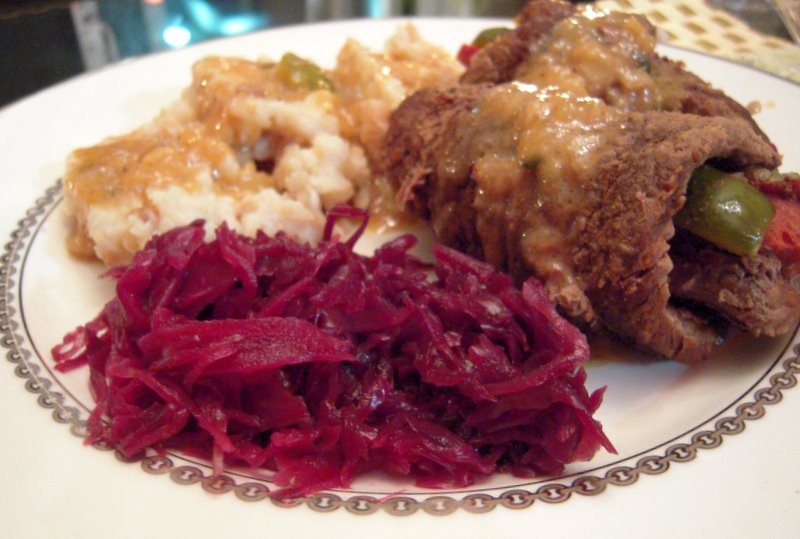
At home, the experimentation continues with sous vide, but thankfully on other nights, there’s been a stark contrast to the new age cooking techniques. We’ve been bringing back old world flavors. Jan has been working for some time to recreate some traditional favorites his Grandma used to make for him in the Czech Republic when he was small. The latest, and one of my new favorites in addition to the fried cheese (link here) is Ptacky.
Ptáčky (pronounced tach-key) is Czech for bird because the brightly colored sausage, pickle and mustard stuffed inside a piece of flattened beef resembles a bird, even though there is no bird in it. Once rolled, the beef is tied and cooked like a stew. Continue reading →
 Seems like I’ve been hearing about quinoa everywhere lately, so realizing I’m probably far behind the times, I decided it was finally time to give it a try. A staple food in South America, quinoa (“keen-wah”) is a grain known for its high protein content. It can be used as a side dish, where rice or pasta might ordinarily be used, or cooked as a part of the main meal.













 Our Life in Meals