Forget cupcakes and cake flavored vodka (all great things!), I’ll take shrimp cakes. They just might be one of the most crispy, delicious bites you’ll eat, especially if you make them yourself. And I’ll never have a pre-made crab cake again.
So maybe that’s a bit drastic, but this all started last week when dinner was in the oven, an hour or so away from being served, and Jan was rummaging around the kitchen for an appetizer for us. I asked if we had any crab cakes, because on occasion, we’ll buy frozen crab cakes as an appetizer to serve with a Sriracha-spiced mayo/yogurt sauce and lemon wedges. After a quick look in the freezer, Jan told me that we did not have any crab cakes, to which I said “OK.” It was just a suggestion, after all, and we had plenty of cheeses to make a mini plate, or some other “fast” foods to rustle up. Continue reading →
The other day, I heard that deviled eggs were, like, so seventies. But, as they’ve recently made their first appearance in our house, they’re new to me. And I’d say pretty tasty too.
But do deviled eggs really need updating from this retro-dish status? Can’t we just leave a classic dish alone? When it comes to fashion trends, I always say, if you wore it the first time it was in style, you’re excluded from wearing it when it comes back. Phew! I’m saved from side ponytails and scruchy socks. And since I wasn’t around in the seventies to eat deviled eggs during their heyday, I think I’m ok to make them now.
I made a batch as an appetizer and modernized them my own way, by slicing the eggs in half with the wavy slicer used to give vegetable slices a corrugated appearance. Voila! Sufficiently 2010. And when one of my dinner guests who hails from the South described the dish as Southern—not seventies—I had a new way to think about deviled eggs.
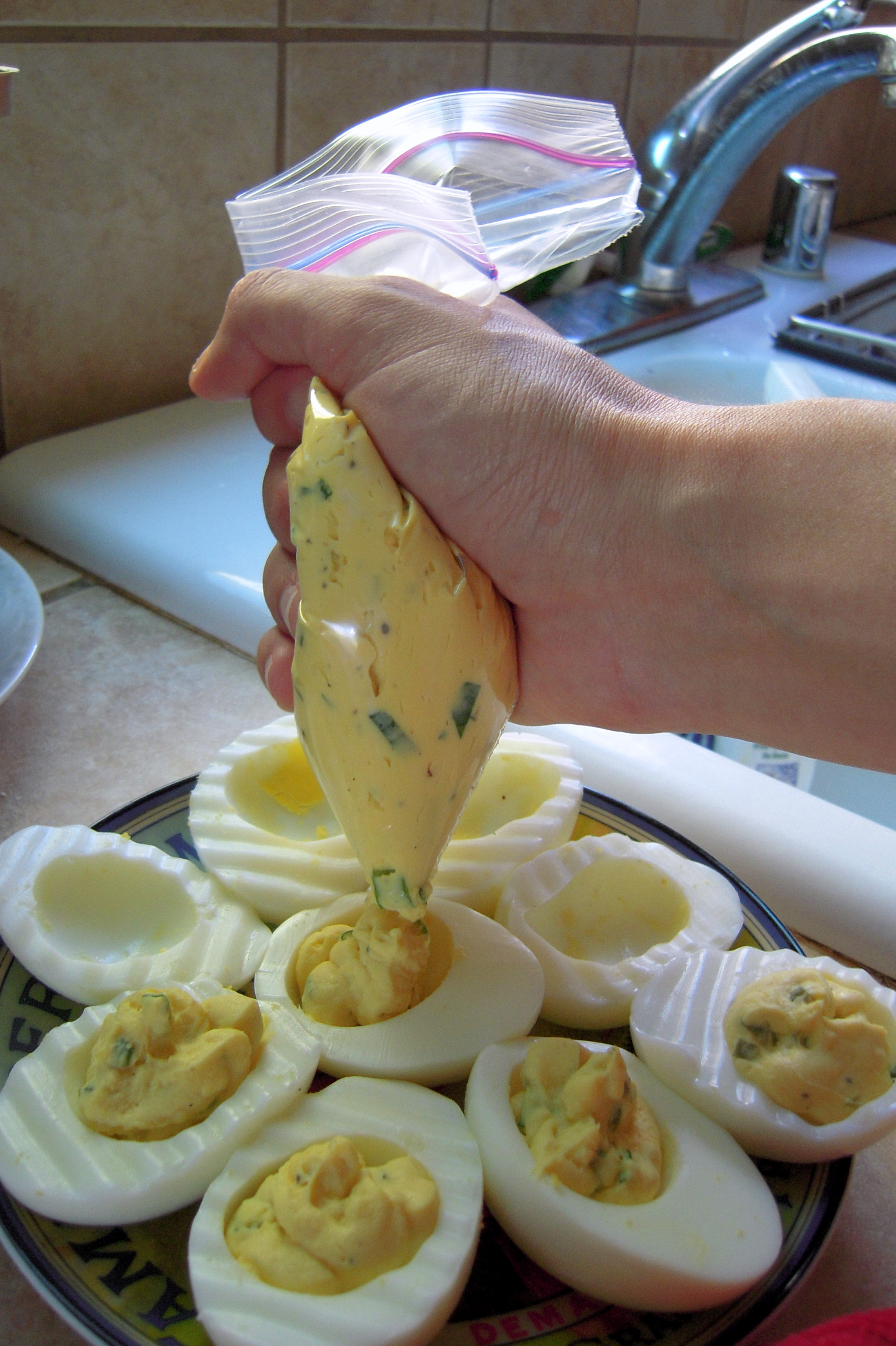
I added horseradish to mine for some kick, and also tried out another technique picked up from the Food Network: impromptu piping bag. I put the egg filling in a plastic bag, cut the end, and was able to create clean-looking deviled eggs! (Which is definitely an improvement over my usual messy spoon technique.)
Hard boil eggs in a pot. My trick for perfectly cooked eggs: place the eggs with a dash of salt in the pan, with enough water to cover the eggs. Cover with the lid and place over high heat until the water is boiling. Remove pot from the heat and let sit, covered, for 20 minutes. Uncover, pour out water into the sink, and allow cool water to run through the pot for several minutes to cool the eggs. Remove the shells right away, otherwise they will stick to the eggs and be much more difficult to remove.
Slice eggs in half, remove the yolks and place in a medium-sized bowl.
To egg yolks, add mayonnaise, mustard, green onions, horseradish, salt and pepper, and combine.
Use a spoon or piping bag to return the mixture to the cavity of the egg whites.
Certain dishes hold an almost legendary status. Everyone probably has a different one that their grandmother, friend, or family member makes. They’ve shared their recipe with you, and yet, your attempts at recreating the original never quite turn out like they should. For me, this recipe has been hummus.
A few years ago, my dad got hummus down to an art. I’d only had restaurant and store-bought versions until he decided he was going to find out the secret behind great hummus. He found it – garlic, and it didn’t take long for us all to start chopping up carrot sticks and pita bread to enjoy it with. Soon, everyone was asking him to make up a batch for parties, bring some over as an appetizer, etc. He even bought a bulk package of these cute little disposable containers to put the hummus in he was giving so much away. And with it, he included the simple recipe on a yellow post-it note each time.
But it didn’t seem to make any difference. I tried to make it on my own, but it never turned out the same. Instead, I’d go over to visit and wait around until he suggested making some for me to take home.
Usually, this method sufficed, but with my dad on vacation, I couldn’t wait any longer for my hummus. I had to give it one last shot. This time, I followed the recipe like I thought I had before. And to my surprise it came out great!
I realized what had been happening in all those other attempts: I’d balked at the sheer volume of garlic in the recipe, and made my own modifications without really realizing it. This time, I squeezed the cloves of fresh garlic through the garlic press one at a time, and threw them all in. (I was desperate for some good hummus!)
The surprise result? It turned out just like dad’s famous hummus. He always swore that the secret was the garlic, but I think I was holding back, afraid of overdoing it. The garlic is needed to add some bite to the earthy flavor of the garbanzo beans and tahini (a paste of ground sesame seeds, available at Mediterranean food markets). And the addition of the sumac (another Mediterranean spice) gives it a rich, authentic flavor.
I got out some crunchy pita chips to enjoy the result: smiles served up with some serious garlic breath.
Cheese and crackers aren’t supposed to be exciting. But call it a Smörgåsbord and suddenly, Jan and I are in. It’s the go-to supper when we don’t really feel like cooking or going out. But it’s also not the meal to make if we’re feeling lazy either, as we typically spend a good deal of time slicing every type of meat or cheese currently in our refrigerator.
Growing up, the Smorgasbord was the typical Christmas Eve dinner in my family. In additional to meats, cheeses, crackers and breads, we’d add special items like smoked Salmon and homemade Swedish meatballs. We’d also make sure to have pickled herring on hand, which I loved as a kid, that is, before I realized that it was pickled fish swimming in a sour cream sauce. Though I went through many years disgusted by it, I’m now slowing letting the little jar back into my life.
And now, even minus the excitement of impending Christmas-present-opening, this dinner is so much fun. Maybe because we have a soft spot for the appetizers-for-dinner meal, or creating each little bite at the table makes us take our time enjoying dinner. I think the best part is trying different combinations and determining the best.
Clockwise from top: spreadable Port cheese, blue cheese, Gruyere, Dubliner, Muenster, double-cream Brie, and Swiss in the center
This last time, Jan raved about the prosciutto paired with aged Parmesan, while I was smitten with the Black Forest Ham and Swiss Cheese on Black Rye bread. While Jan got creative with his presentation, drizzling balsamic vinegar over a log of goat cheese and sprinkling chopped fresh basil on top, I took it one step further and spread this mixture on a slice of Granny Smith apple for a surprisingly tasty combination.
While some items make it back for another Smorgasbord dinner, each of these meals is never the same, and maybe that’s why it’s so exciting. Something traditional and simple can sometimes lead to innovation, if we’re willing to try something new.
Growing up in Fresno, California, I took stuffed grape leaves for granted as staples at any deli counter. As a kid, I met them eye-level through the display glass with a mix of awe and suspicion. They might be considered a standard dish in many Mediterranean cuisines, but in my mind, all I saw was a dark, glossy green roll, delicately wrapped up and eerily finger-sized.
Depending on who you talk to, they can be called dolmas or sarmas, and the words literally translate to “stuffed things.”
I hadn’t thought about the dolma much until this year, when my daily drive took me past miles of vineyards on the outskirts of Fresno. With the top grape acreage of any county in the United States, that translates to lots of wine, raisin, and table grapes. And while Jan and I often find ourselves enjoying products made from grapes (with wine being the clear winner), there’s another product that comes from these grapevines that we often overlook, the leaves.
Jan has always loved stuffed grape leaves, and likes to try offerings at local markets and sandwich shops in search of the best. He’s even purchased canned stuffed grape leaves, though those left much to be desired. I’ve always found the briny taste of the grape leaves too overwhelming to enjoy them, so tackling this dish was a good challenge for us. And while I knew the results wouldn’t turn out like anyone’s grandmother’s, I hoped they might come in somewhere in between the canned version and the deli counter’s.
Start with grape leaves in a jar
I went to a Mediterranean market to purchase the grape leaves, which came in a large jar. The grape leaves had to be removed and unfolded carefully, so they would not rip. Because the grape leaves are soaked in brine, I rinsed thoroughly to remove as much extra salt water as I could.
Combining beef, lamb, rice, butter, water, and spices
You can get creative with stuffings, but the classic is rice and meat, and we chose a recipe that had a higher meat to rice ratio. We ground up cuts of beef and lamb in our meat grinder, and our ratio was about two-thirds beef to one-third lamb. The meat is mixed with uncooked rice, which will cook together with the meat once wrapped in the grape leaf.
Carefully wrapping
Rolling them was both fun and tricky, and I had to keep reminding myself that the stuffing would double in size while cooking. If wrapped too tightly, the grape leaf could break during cooking as the filling expands inside.
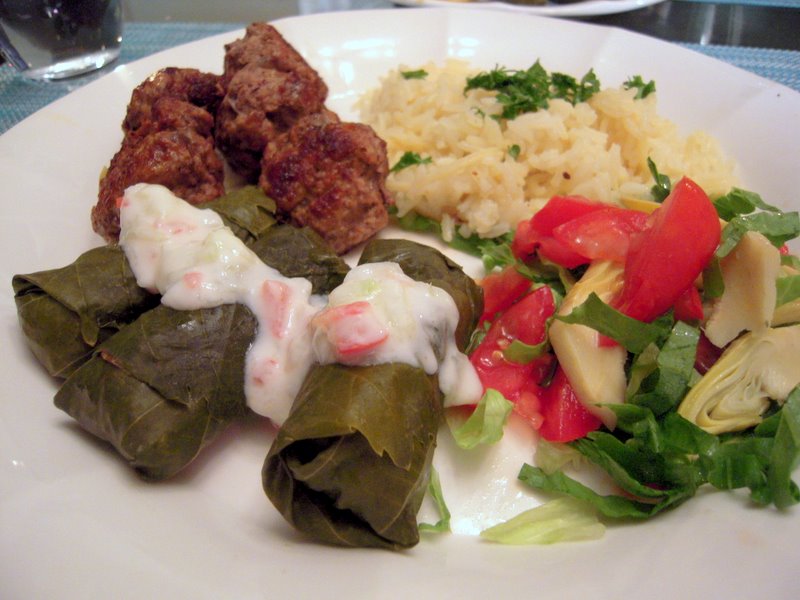
Served with beef and lamb meatballs, rice pilaf, and salad
We enjoyed them with a hummus appetizer, lamb and beef meatballs (made with the leftovers of the meat we ground for the dolmas), cucumber and tomato yogurt sauce, and rice pilaf.
And I must say that the stuffed grape leaves were a winner! The cayenne gave the stuffing a bit of a welcome kick, and the meat and rice was perfect, providing just the right balance to the flavor of the grape leaves. Serving with the yogurt dipping sauce took the dolmas up to the next level, and we will definitely be making these again. After seeing them come together from the inside out, I won’t be that skeptical kid at the deli counter anymore. In fact, I might even call myself a fan.
Carefully remove the grape leaves from the jar, unfold, and rinse thoroughly. Set aside. In a bowl, combine beef, lamb, rice, butter, tomato paste and salt. Add pinches of black pepper, cayenne, basil, and savory. The last ingredient to be added is the warm water.
Mix the mixture with your hands until combined, then let the mixture rest for a few minutes before rolling in the grape leaves. While the mixture is resting, line the bottom of a pan with grape leaves, to protect the stuffed grape leaves while cooking.
Carefully wrap about one tablespoon of stuffing with one grape leaf. Form a cylinder shape with the stuffing at the base of the grape leaf. Fold in the bottom and sides and carefully wrap into a roll. Place in the pan on top of the grape-leaf-lining, with the point of the leaf down.
Place the stuffed grape leaves atop a bed of grape leaves
Once you’ve used all your stuffing (this recipe makes about 20 dolmas), and filled the pan with a single layer of grape leaves, add enough water to cover them, along with about half a teaspoon of oil. Cook on medium heat for about 20 minutes, or until the rice is tender.
Cooking in water, which will boil away
While they are cooking, make the yogurt dipping sauce (see below). After about 20 minutes on the stove, you may have to sacrifice one to test if it’s done. The liquid should have boiled away and you will be left with shiny dolmas that are deeper in color than the uncooked versions.
When done, they're a deep, dark green
For the sauce, you will need about half a cucumber, 1-2 tomatoes, plain yogurt, and lemon juice. Peel the cucumber, cut in half, and remove the seeds with a spoon. Use a cheese grater to shred the cucumber, and place into a bowl. Add diced tomato, about 1 cup of plain yogurt, and about 1 tablespoon of lemon juice. Stir and refrigerate until ready to serve. Can be served atop the stuffed grape leaves or as a dipping sauce on the side.
I haven’t taken a cooking class since Home Ec, so when a group of my girl friends decided to host a get-together at the Whole Foods demonstration kitchen, I was excited.
The evening’s theme was Spanish tapas, and our chef Hillori explained that tapas were small bites eaten in bars and were traditionally made on large platters and served with toothpicks. Establishments used the honor system; at the end of the night, you’d bring up your pile of toothpicks to be counted so that you could pay for what you ate.
Luckily, we had no such system tonight to keep track of the amount we ate, otherwise my toothpick pile might have looked more like a mountain by the end of the evening!
We started by making prosciutto, manchego and fig tartines. We combined butter with fig preserves and spread over small pieces of baguette. Then, we topped those with prosciutto (can also use Serrano ham) and pieces of manchego cheese (a hard cheese that Hillori cleverly sliced with a vegetable peeler). Once plated, the tartines were drizzled with olive oil and topped with salt and pepper.
We then made a few things to accompany some of the later dishes: almond and parsley salsa verde, and lemon and garlic aioli. We made piquillo peppers stuffed with goat cheese and served them with the salsa verde, then garlic shrimp with sherry and fresh parsley. Lastly, we sampled spicy chorizo served with the aioli for dipping.
I felt like I was on the set of a cooking show from the Food Network, except this time, I could ask the chef a question and get an answer right away, it was great. I kept leaning forward in my seat to get a better look at the food preparation, forgetting about the ceiling mirror that offered a better view.
Everything was rich and delicious, and I love that the class forced me to step outside my comfort zone and try things I normally wouldn’t. I used ingredients that I would never think to buy, or use. And I found several uses for the parsley that’s growing rampant in the garden right now.
On all the dishes, olive oil was used in abundance, something that bothered me at first, but I told myself to go with it. When in Spain… right? Besides, the liquor license for the demonstration room was still in the works, so we couldn’t yet sip on Spanish wine while we did our cooking. By the end of the night, I was so stuffed with the flavors of Spain, I felt like I had drank a bottle of wine myself.
The girls and I made a date with Hillori for another class focusing on making quick and easy desserts, and my sweet tooth can’t wait.
 Forget cupcakes and cake flavored vodka (all great things!), I’ll take shrimp cakes. They just might be one of the most crispy, delicious bites you’ll eat, especially if you make them yourself. And I’ll never have a pre-made crab cake again.




 Our Life in Meals